Three stories of false positives in astronomical discovery.
According to the DRAE, fantasma is:
-m. Image of an object that remains imprinted on the fantasy.
-That which is nonexistent or false.
Here, three stories of objects that remain only in fantasy, nonexistent, false positives.
1-The case of Fomalhaut b
In 2008, astronomers found a planet around the star Fomalhaut, through the review of archive images from Hubble. We reported it here back then.
But there were data that did not fit. For example, that it was bright in visible light and had no clear signature in infrared. But stranger was later, when with data from 2014, the supposed planet was no longer there. This is reported by Andras Gaspar and George Rieke, from the University of Arizona in PNAS.
Instead, what the authors deduce is that the supposed planet was the remnant of the collision of two planetesimals. Although originally believed to be a massive exoplanet, its faint infrared brightness and the non-detection of perturbation of the debris ring around the star, indicates it is a low-mass object. With the available data it is inferred that it is now less bright and has grown in extent, with a motion consistent with an escape orbit. Such behavior confirms suggestions that the source is a dispersing dust cloud, produced by a collision between two small objects.
But the story has a positive side: it would be the first time that a catastrophic collision in an exoplanetary system is observed directly.
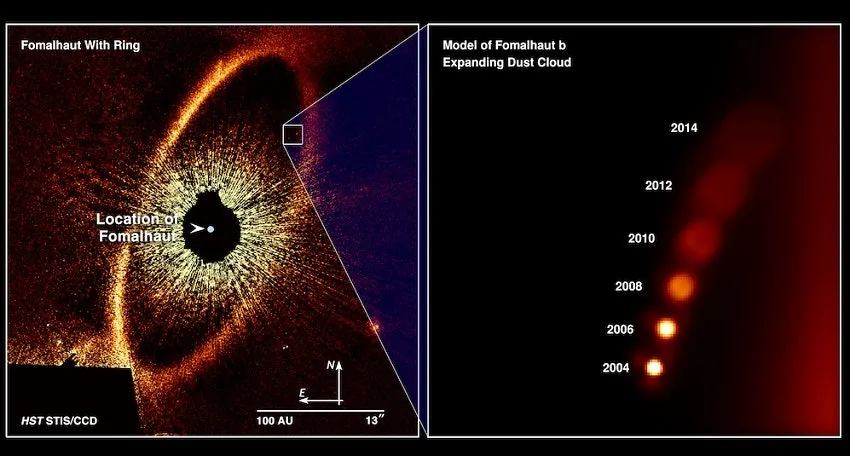
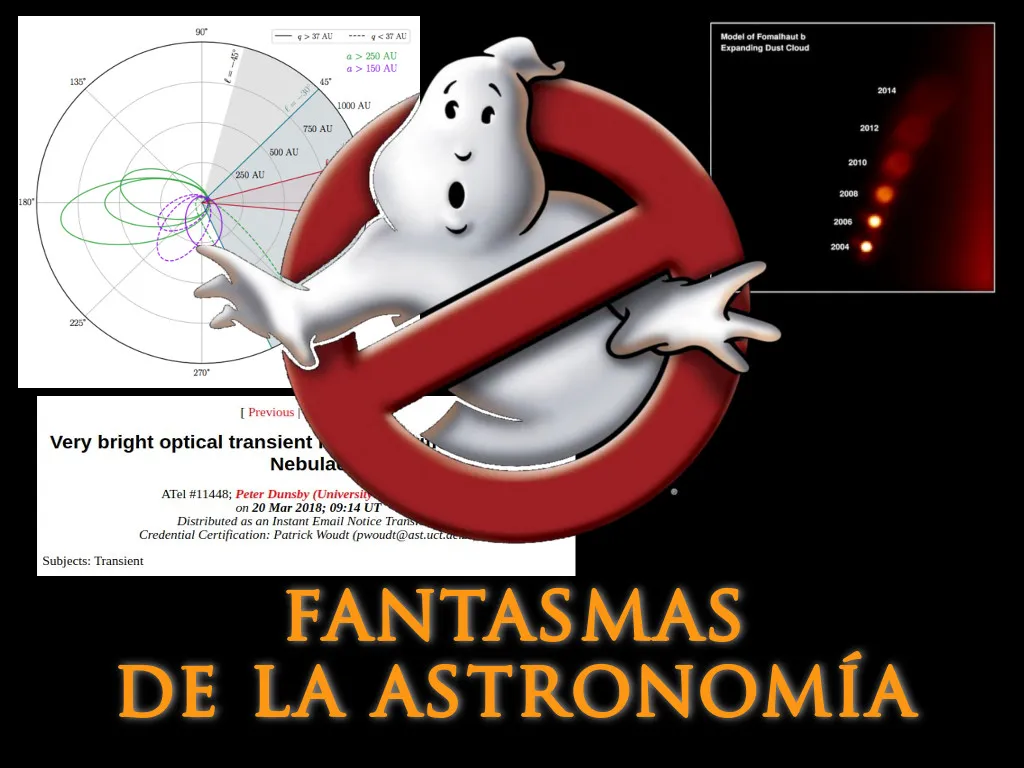
In this video, the suspected exoplanet is seen over time (date bottom right) and it is perceived how it becomes fainter until it disappears.
2- Planet 9 and the not-so-rare alignment of eTNOs
Beyond the orbit of Neptune lie the Trans-Neptunian Objects (TNOs), rocky, icy. The authors in this case set out to test the hypothesis of astronomer Michael Brown about the possible existence of a super planet out there, using the data from the Y4 survey of the Dark Energy Survey (DES). Although such data are collected to search for and study dark energy, they have served to detect extreme TNOs, also called eTNOs.
Based on the observations from DES, it can be seen that there are some TNOs aligned, which generated the hypothesis that this was the product of a massive planet, the ninth planet of the solar system.
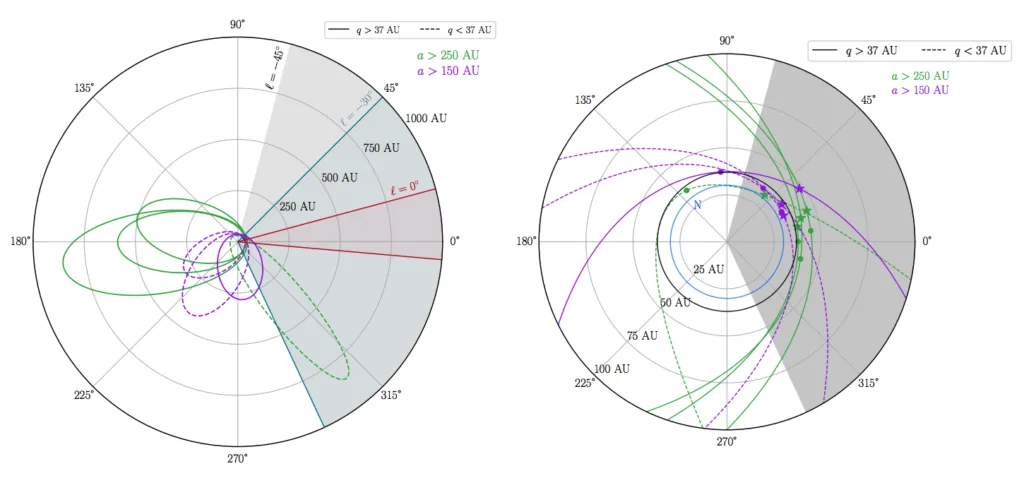
The idea is that, what seems strange, may not be. Simply, appearances are deceiving. That is the hypothesis of the work that proposes that if more TNOs were observed, it would be seen that these few do not have a "special" alignment, but are distributed in a homogeneous (isotropic, no preference in a direction) way. For this purpose, they simulated a population of 40 million TNOs with random orbital parameters. Then they reduce that population, to include only the eTNOs that could be observed with DES and made statistical comparisons.
Finally, the authors were able to recreate the orbits of the known TNOs using an isotropic distribution of the population. Therefore, if correct, there is no need for the Planet 9 hypothesis. But the results are not conclusive, so a window remains open. With more data, it could be closed.
3- A star as red as Mars
In 2018, an astronomer from the University of Cape Town in South Africa reported in Astronomer’s Telegram, a very bright object near the Trifid Nebula. This report was made on Mar 20, 2018; 09:14 UT.
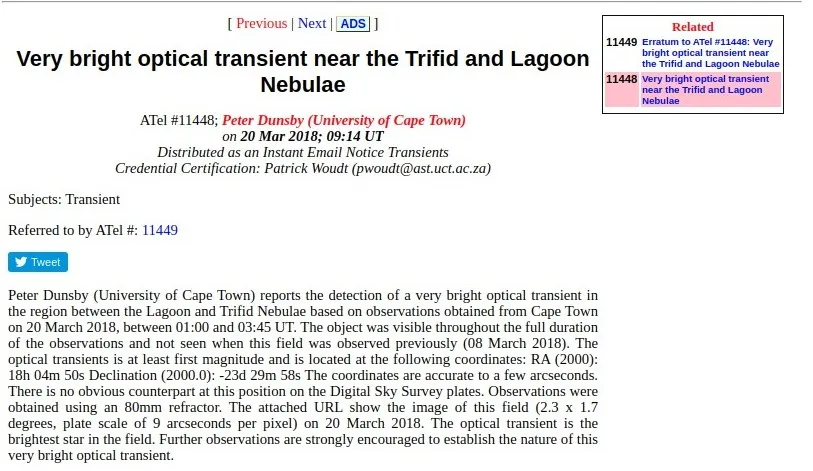
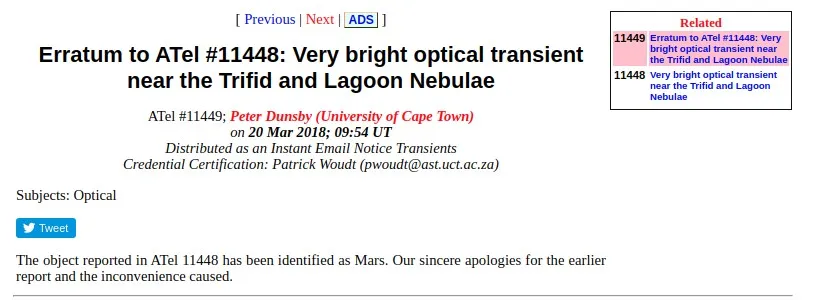
A while later, Mar 20, 2018; 09:54 UT, another report from the same astronomer was more succinct:
"The object reported earlier has been identified as Mars. Our apologies for the previous report."
MORAL
It is easy to find ghosts where there are none. The hard part is realizing it.
Sources and related links
- Astronomer finds star that never was
https://cosmosmagazine.com/space/astronomer-finds-star-that-never-was - Planet that never was is still interesting
https://cosmosmagazine.com/space/planet-that-never-was-is-still-interesting - Hubble observes planet orbiting Fomalhaut
https://www.noticiasdelcosmos.com/2008/11/hubble-observa-planeta-orbitando.html - New HST data and modeling reveal a massive planetesimal collision around Fomalhaut
András Gáspár and George H. Rieke
PNAS first published April 20, 2020 https://doi.org/10.1073/pnas.1912506117 - arXiv:2004.08736 [astro-ph.EP]
https://arxiv.org/abs/2004.08736 - New Research Suggests Fomalhaut b May Not Be a Planet After All
https://www.universetoday.com/93007/new-research-suggests-fomalhaut-b-may-not-be-a-planet-after-all/ - An Alternative to Planet 9: Maybe there is nothing special
https://astrobites.org/2020/04/18/an-alternative-to-planet-9-maybe-there-is-nothing-special/ - Testing the isotropy of the Dark Energy Survey's extreme trans-Neptunian objects
Pedro H. Bernardinelli et al
arXiv:2003.08901 [astro-ph.EP]
https://arxiv.org/abs/2003.08901 - Erratum to ATel #11448
http://www.astronomerstelegram.org/?read=11449
About the images
Figure 1: NASA, ESA, A. GÁSPÁR AND G. RIEKE/UNIVERSITY OF ARIZONA.
Figure 2: Pedro H. Bernardinelli et al.
Figure 3: http://www.astronomerstelegram.org/