A friction mechanism may have been detected to explain the "angular momentum loss problem" in planet-forming disks.
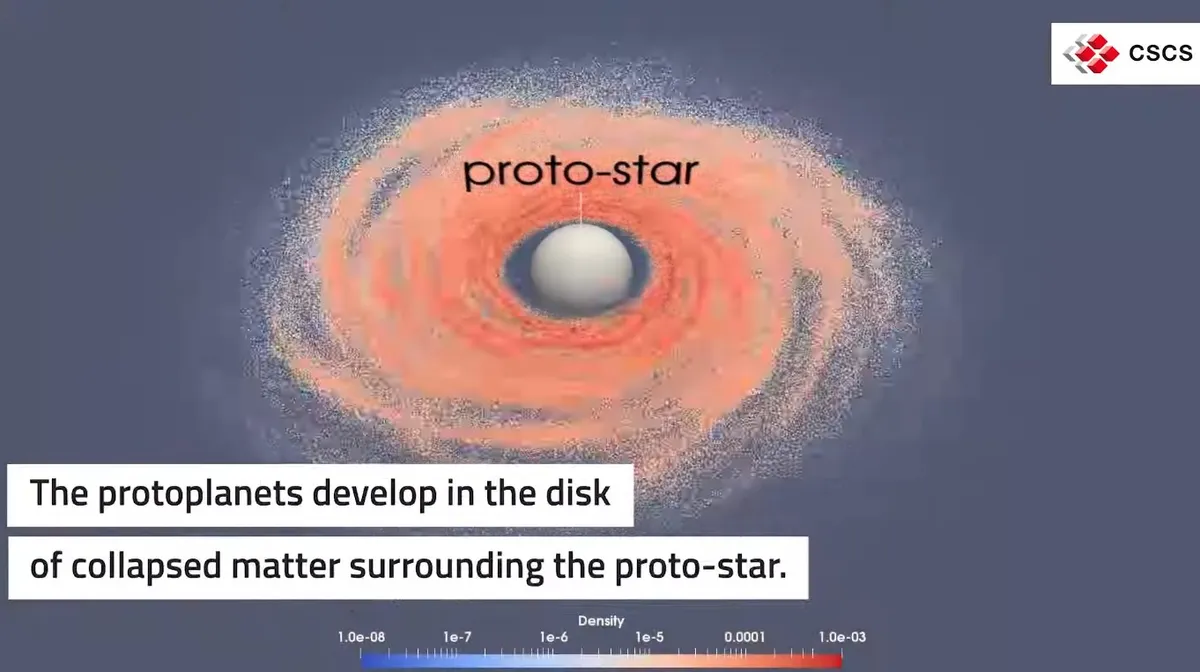
Earth and other objects in the Solar System formed from a disk of gas and dust around the Sun. To investigate this process, astrophysicists use computational simulations to understand the mass growth, as well as the development of a planet's magnetic field. However, gravity and magnetic fields are usually modeled separately. Now, Lucio Mayer, from the University of Zurich and others, combined both processes in a simulation. The results were published in The Astrophysical Journal.
Two models in one
Astrophysicists know that gravitational instability in a massive rotating disk of matter plays a key role in planet formation. It causes particles to clump together, which allows the formation of high-density structures like spiral arms. The effects of the magnetic field during gravitational instability have not been taken much into account, until now.
With the help of Piz Daint, the supercomputer at the CSCS center, these scientists simulated a protoplanetary disk under the influence of gravity in the presence of a magnetic field. This led them to discover a new mechanism that could explain previous observations.
For example, the planets in our Solar System rotate more slowly than the protoplanetary disk from which they emerged. During the formation of planets, as well as stars, enormous amounts of angular momentum are lost, but how it happens is not clear. This is the angular momentum problem. "Our new mechanism seems capable of solving and explaining this general problem", Mayer indicated.
To combine both processes in a simulation, the researchers used a hybrid method to calculate the magnetic field, gravity and fluid dynamics. In this method, the mass and the gravity exerted are calculated using particles, each representing a piece of the system.
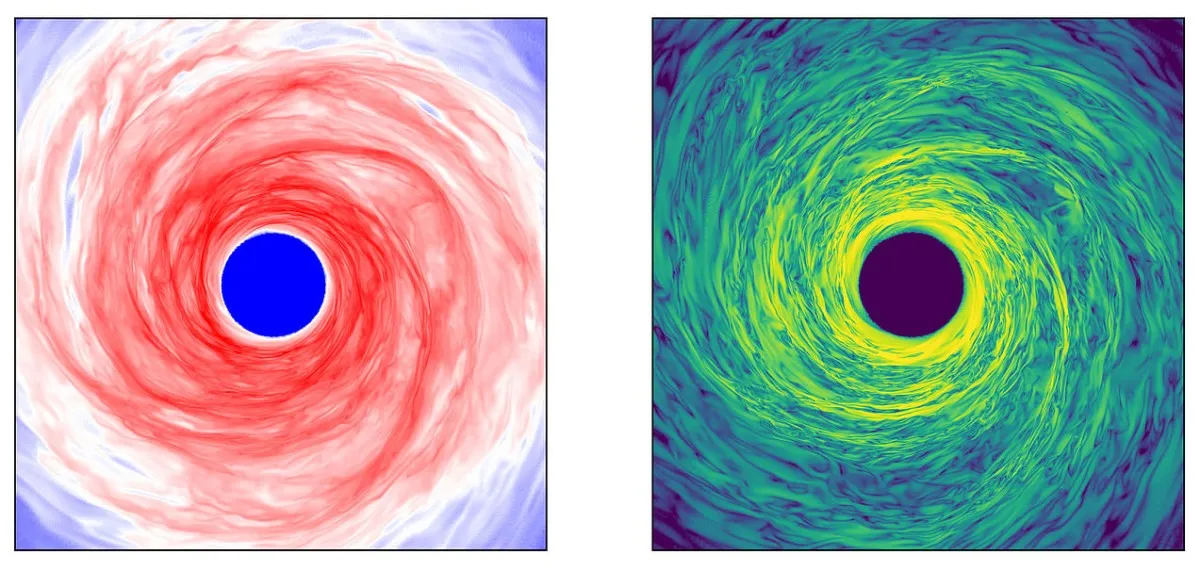
The model shows that the spiral arms formed by gravity in the protoplanetary disk act as a dynamo, extending and strengthening the magnetic field. This dynamo generates an inward and outward push.
"The simulation shows that the energy generated by the interaction of the magnetic field with gravity acts outward and generates a wind that expels matter from the disk", commented Mayer.
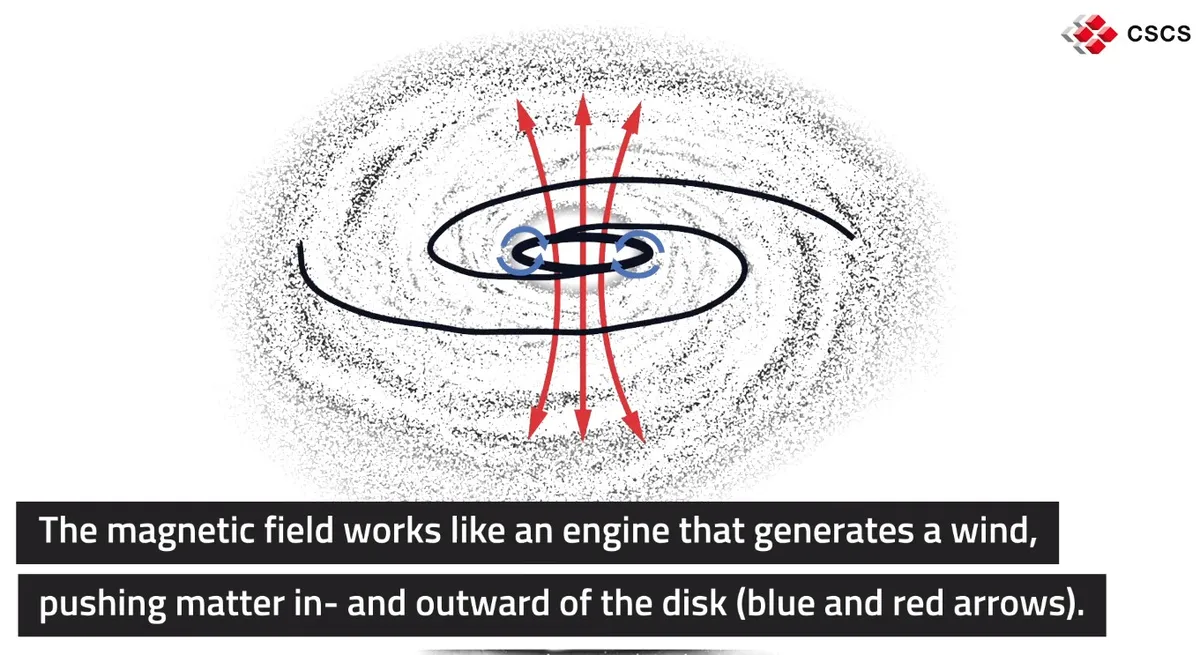
This would cause the loss of 90% of the mass in less than a million years.
"If this is true, it would be a desirable prediction, because many protoplanetary disks that are a million years old have 90% less mass than predicted by disk formation simulations, until now", explained the astrophysicist.
Finally, the loss of energy leads to matter collapsing and losing rotation. The researchers now hope to be able to observe those winds and the expulsion of matter in early phases of a protoplanetary disk, with powerful telescopes like those of ALMA or the SKA under construction.
The researchers believe they have discovered a new friction mechanism generated by the interaction of the magnetic field and gravitational instability that significantly erodes the angular momentum of the disk.
"Thanks to the powerful engine of the spiral arms, our new friction mechanism seems more efficient in dense regions of protoplanetary disks where there are fewer charged particles to sustain the magnetic field", added Hongping Deng, co-author of the work.
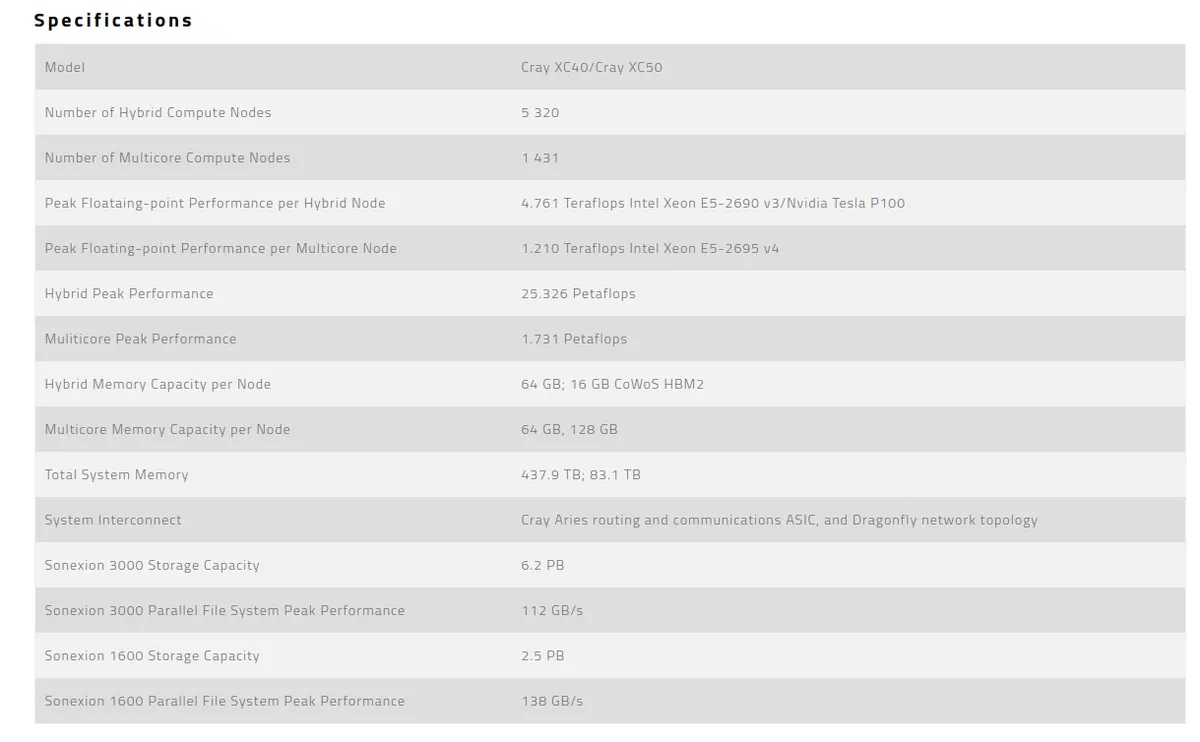
Piz Daint
Piz Daint is a supercomputer that was named after a great mountain in the Swiss Alps. It occupied the 8th position in the TOP500 supercomputer ranking until the end of 2015. In 2016, with an update it managed to reach 25 petaflops and climbed to 3rd place. Since 2018 it has been ranked 6th in the prestigious ranking.
https://www.youtube.com/watch?v=qFls_kKczN0
Sources and related links
- SIMULTANEOUS SIMULATION OF GRAVITATION AND MAGNETISM OF A PROTOPLANETARY DISK
https://www.cscs.ch/science/physics/2020/simultaneous-simulation-of-gravitation-and-magnetism-of-a-protoplanetary-disk/ - Protoplanetary disks
https://sciencenode.org/feature/Protoplanetary%20disks.php - Deng H, Mayer L & Latter H: Global Simulations of Self-gravitating Magnetized Protoplanetary Disks, The Astrophysical Journal (2020), 891, https://doi.org/10.3847/1538-4357/ab77b2.
About the images
Images from CSCS; Mayer et al (2020).