A possible planet in the HD 104067 system could suffer tidal tugs from its star and two other planets enough to make it incandescent.
More than 5,000 exoplanets have been discovered since the 1990s. Some are incredible places, worthy of a movie. That seems to be the case for a possible exoplanet found recently.
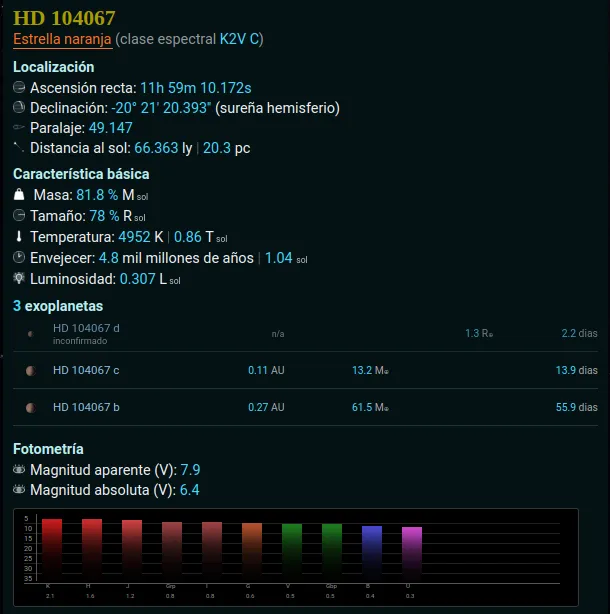
The HD 104067 system has been known for some years. It is composed of a K-type star, a bit smaller than our Sun (80%), with an apparent magnitude of 8, at 20pc (65 light-years) away. In 2011, the discovery of an exoplanet of ∼0.2 M and an orbital period of 55 days was announced. In 2021, another team confirmed its existence.
In May, a group of astronomers led by Stephen R. Kane (University of California) with TESS data discovered another exoplanet: a sub-Neptune (HD 104067 c) and the possible existence of a terrestrial world, with a period of 2 days, designated as TOI-6713.01, with TOI being the acronym for "TESS Object of Interest". The second planet was detected by the radial velocity method; while the third, by the transit method.
TESS is the name of the satellite "Transiting Exoplanet Survey Satellite" launched by NASA in 2018, to discover extrasolar planets.
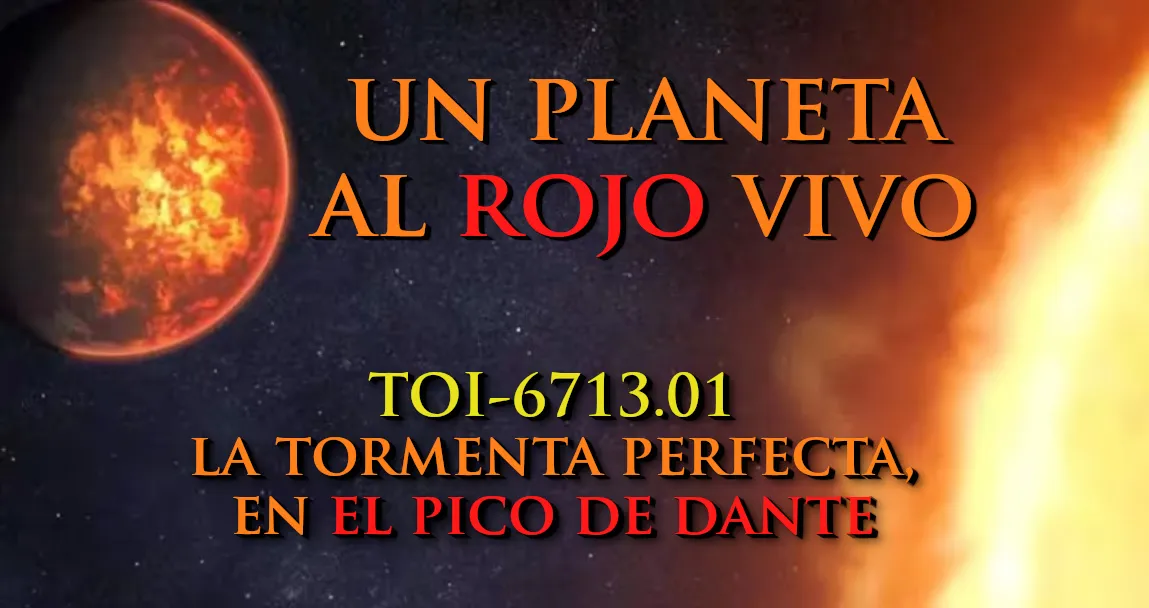
The new planet, rocky, 30% larger than Earth, resembles Jupiter's moon Io. "It's a terrestrial planet that I would describe as Io on steroids," said Kane. "It's forced into a situation where volcanoes are constantly exploding. At optical wavelengths, you would be able to see a bright planet, red-hot, with a surface of molten lava," he added. The calculations -in the work published in The Astronomical Journal- indicate a possible temperature of 2600 K.
The moon Io, at Jupiter, is the most geologically active object in the solar system, with more than 400 volcanoes. The satellite is the closest to the gas giant. Along with the planet's gravity, the other moons force Io into an eccentric orbit and constantly tug at the world's surface.
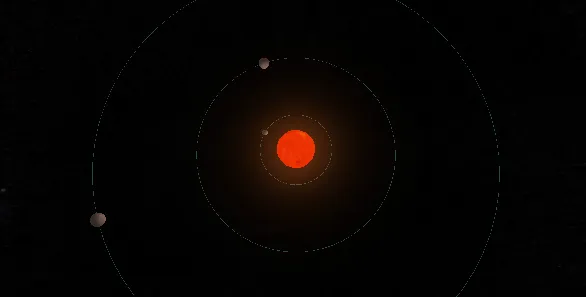
In an analogous way, there are two planets in the HD 104067 system, farther from the star than TOI-6713.01 and larger. Those planets also force the closest one into an eccentric orbit that squeezes it with large tidal forces, which tug more on one side of the planet than the other.
If the existence of this rocky and possibly volcanic planet were confirmed, in addition to its official designation, it could be called "Dante's Peak", in Spanish "El pico de Dante", which besides referring to a fictional place in the movie of that name, where a volcano erupts, also refers to Dante Alighieri. And TOI-6713.01 indeed seems to be a hell.☉
Sources and related links
- A Perfect Tidal Storm: HD 104067 Planetary Architecture Creating an Incandescent World
Stephen R. Kane et al 2024 AJ 167 239
DOI 10.3847/1538-3881/ad3820
https://iopscience.iop.org/article/10.3847/1538-3881/ad3820 - Squeezed by neighbors, planet glows with molten lava
https://news.ucr.edu/articles/2024/05/09/squeezed-neighbors-planet-glows-molten-lava - Wikipedia: HD 104067
https://en.wikipedia.org/wiki/HD_104067 - Stellar Catalog: HD 104067
https://www.stellarcatalog.com/estrellas/hd-104067 - Exoplanet Archive: HD 104067
https://exoplanetarchive.ipac.caltech.edu/overview/HD%20104067
About the images
NASA, ESA, CSA, Dani Player