Reflection and greeting for the new year.
Toward the end of 2021, an online video platform presented the film "Don't Look Up," about the end of the world. It's a parody, in the style of "The Wolf of Wall Street," a genre I don't usually like too much. In any case, perhaps due to the coincidence with the end of the year, the pandemic, and other similarities with reality, I started thinking about a specific topic: "The Inevitable."
It's an old topic, which gave rise to an unresolved debate: Free Will vs. Determinism.
The year begins, it's a festive time and I don't want to be a bore. But a minimal review of that dilemma is worthwhile.
Although there are several ways to define free will, one possibility is to consider it as people's ability to define their behavior exclusively by their own will. Like it or not, this cannot be true. It's easy to see: in part, we humans have robotic, automatic behavior: blinking, reflexes, heart rate do not depend on our will. The functioning of our organism, organs, and brain does not depend entirely on our will. We can take care of our health or not, but we have DNA. It's true that currently there are genetic modification technologies, still exceptional. Nor does the weather depend on our will, although human actions can - in the long term - worsen the environment.
Therefore, free will, thought of in this way, is unsustainable. We are left with two deterministic alternatives: the strong and the weak. The first, based on physics, stipulates that everything that exists, including people, are conglomerates of particles. These particles can be thought of as little balls in a great game of billiards. The behavior of these little balls does not depend on their will, but only on physical laws and initial conditions. Thus, everything that happens today is inevitable, determined since the Big Bang. Human decisions would be illusions and not true decisions born of will. This creates a moral problem: if human actions are not decided by anyone, but an unavoidable consequence of the original conditions, then there can be no evil or crimes.
Those particles don't have a brain, but people do. And physicists have no idea how such particles work in our brain, how they form ideas, thoughts, emotions, memories.
Weak determinism postulates that everything that happens is the result of something prior. Therefore, everything is determined by causes that are previous. Action is determined by thought and restricted by natural and social variables. Thought itself is not free. We don't think "at will." Let's look at a couple of examples:
Could a person born in the 10th Century think that the center of the universe was the Sun and not the Earth? Or think about other galaxies? Or about pulsars? Or about smartphones and artificial satellites?
There have been some visionaries, with fruitful imagination, like Giordano Bruno. But there is a distinction between imagination and knowledge. The existence of the ether was also imagined, or that in the year 2000 we would all use flying cars, or that Mars had inhabitants who built canals.
This implies that not only can we not act with total control of our will, but we also cannot think as freely as we might believe. We are children of our historical time, determined or conditioned by existing knowledge, prevailing technologies, and social discourses. Hence the importance of freedom of expression and the possible influence of the media (for bad and for good).
Let me give another example, quite extreme: Let's imagine that a person, from birth, is subjected to strong indoctrination. They are taught that there is a superior being who wants the infidels to die. And that the faithful who do so will have eternally happy life in paradise. Such a person is not allowed to read books, watch movies, television, access the internet. This individual is only exposed to a certain type of discourse and prevented from having contact with other discourses. [This conditioning was imagined by Aldous Huxley in Brave New World].
Then, at a certain age, the person's body is filled with explosives and they are left in the center of a large city. How many real possibilities does that person have of doing something other than pressing the detonator? Everything they were taught, everything they know, what their parents, their superiors, their moral authorities, their friends, their society instilled in them, points in only one direction. Does that person have the possibility to act differently? One possible answer is yes, by virtue of the survival instinct. But this person has also been told that if they do not fulfill that divine mandate, then they will be a traitor and they will be killed. Isn't the end of this scene inevitable? Did that person have the possibility to think and act differently? Prepare for a difficult question: And if they do it, are they guilty? What fault do they have?
Aside from guilt, the example attempts to show the power of others. The power of social discourses, which include not only the mass media, but also family, school, neighbors, etc., that is, society.
Thus, we arrive at this possible conclusion:
We cannot decide our actions with total freedom, the exclusive fruit of our will. But we do have will and we can decide, in a restricted way. Nature, the environment, and DNA limit us; as well as social conditioning. We are not free, but we have conditional freedom.
But we can change things, thanks to joint effort. The cooperation of many can "move the world." The flip side of this is the other possibility: indifference. Since we have will, we are responsible for our actions. But we cannot be responsible if we do not have freedom of knowledge and expression. We must have the possibility to access different discourses to compare them and choose. Otherwise, we cannot choose. And we cannot blindly believe anyone. We must develop our own thinking, even if it is inevitably influenced by the thinking of others. Hence the importance of the richness of diverse communications, of different ideas communicated so that others can think about them.
That is the ultimate and first purpose of this humble blog. We navigate social discourses in a turbulent cosmic ocean. There are fake news, myths, economic or political interests that carry water for their own mill. People like Di Caprio's character in that movie, who let themselves be blinded by a little bit of power and fame.
There are people who agree with these ideas I have just presented, but when it is their turn to communicate, they fall silent. Freedom of expression and freedom of knowledge are inseparable.
2022 finds us navigating these challenges. For people who were 20 years old or older in 1990 (born in 1970 or earlier), the Hubble Space Telescope was "THE" telescope of their lives. Let's note that most astronomical research is done with other instruments, which are many and also very good.
Now, that place will begin to be occupied by the James Webb, after so many delays. That illustrates the point: knowledge is not a product of chance, but of collective will, which is the sum of individual wills.
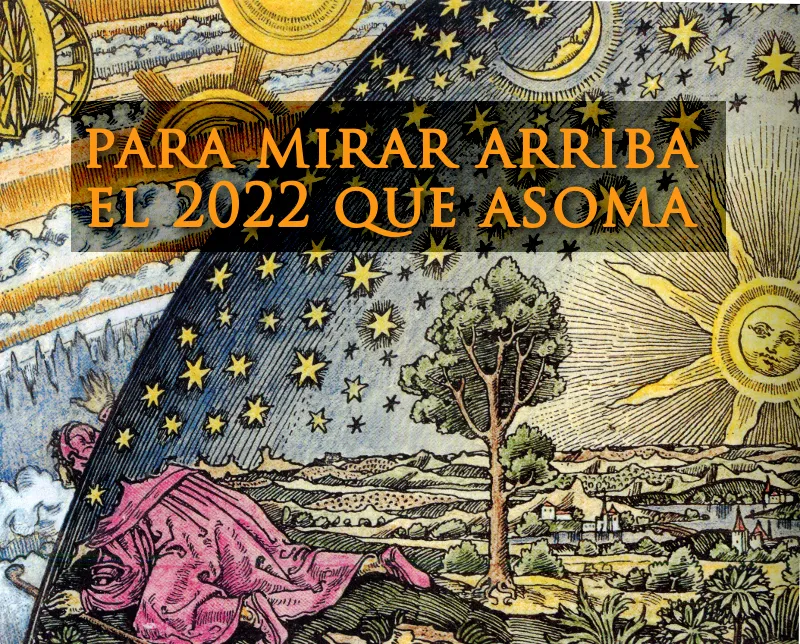
If expressing wishes serves any purpose, then: May this new calendar year bring us more telescopes for everyone (not fewer), more vaccines, more health, more work. Let's strive to treat each other better, to have more empathy for those in need, let's help those we can. Endless discussions are exhausting. But let's not be so indifferent. In the end, we will all leave. It's inevitable. But let's leave behind a path of seeds. That way, when night comes for us, we can look up.
Greetings to all.