At what speed are we moving?
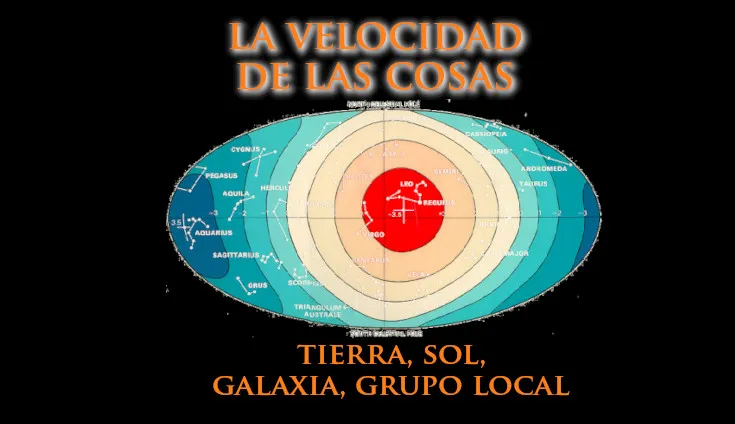
Surely you are reading this post while sitting, still, at rest. With respect to what?
The Earth rotates on its axis. We move even while we are sleeping. At what speed does the world spin?
The planet has a diameter of about 12 thousand km. As it rotates, it "draws" a circle. The circumference is 2πr ~ 40 thousand km. And it takes us 24 hours to complete that turn, which gives us a speed of 1670 km/h. Of course, this is valid for the area of the Equator. At higher or lower latitudes, the diameter and therefore, the circumference will be smaller.
We can calculate the orbital speed in the same way: suppose the Earth's orbit were a circle, its radius is 150 million km (one Astronomical Unit). And it takes us 365 days. We apply 2πr to calculate the circumference: ~940 million km. We convert days to hours and divide distance by time. Result: 107 thousand km/h.
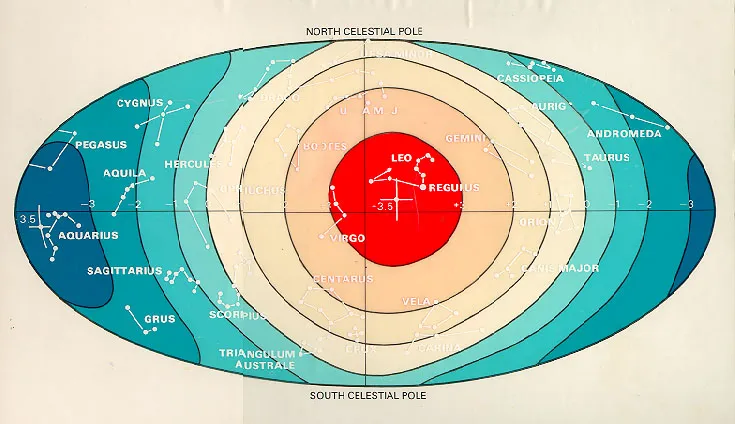
[Fig 1]: CMB anisotropy map from the experiment on the U2.
The trip around the galaxy
The Solar System lies about 26 thousand light-years from the galactic center. It is estimated that the galaxy takes 250 million years to rotate. Following the same reasoning, v=d/t. For this we must first convert light-years to km. 1 light-year is approximately 9.4 thousand million km. And then time in hours: 250 million years*365*35. Finally, we obtain the staggering figure of 720 thousand km/h.
Relative to the most distant galaxies, half the journey we move toward them and the other half, away, so that ultimately, we maintain the relative position. Although, watch out for M31!
These velocities cannot be added. Earth is tilted 23.5º relative to its orbit and the Solar System "goes up and down" in the plane over time.
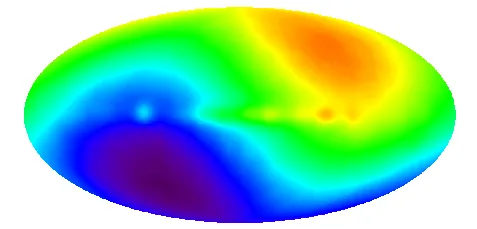
[Fig 2]: Map with COBE data.
The Local Group
The Milky Way is gravitationally bound with another twenty or so galaxies, which together form the Local Group. The galaxy moves at a speed of ~ 450,000 km/h (123 km/s) relative to the others in the group, according to a work by Karachentsev et al. (2006).
THE TOTAL VELOCITY
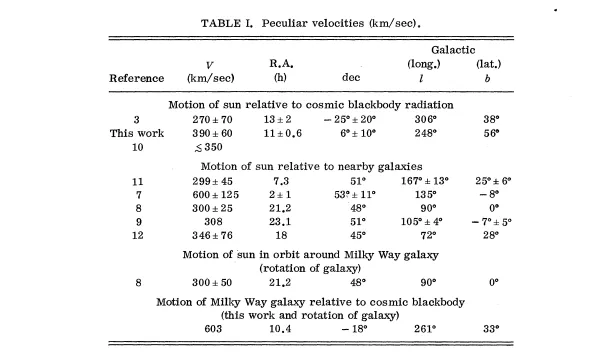
One can try to measure Earth's velocity against something that cannot. What is done is to consider Earth's motion against the cosmic microwave background radiation (CMB). In the 1970s this was measured for the first time with instruments mounted on a U-2 aircraft [Fig 1]. Later, with the COBE satellite, this dipole created by the radiation in the direction of Earth's motion was also detected, which appears blueshifted, therefore, hotter; while the radiation in the opposite direction appears redshifted. Calculations indicate that the Local Group moves at 600 km/s relative to the CMB. That's over 2 million km/h [Fig 2].
ASTRONOMICAL IMPORTANCE
Beyond curiosity and the high values, these calculations have scientific value. When astronomers study celestial objects and do spectroscopy, they detect Doppler shifts, but they must subtract the Earth's motion. It is especially important when searching for exoplanets.
What is still not known is who holds the ring of this cosmic carousel.☉
Sources and related links
- Detection of Anisotropy in the Cosmic Blackbody Radiation
G. F. Smoot, M. V. Gorenstein, and R. A. Muller
Phys. Rev. Lett. 39, 898 – Published 3 October 1977
https://journals.aps.org/prl/abstract/10.1103/PhysRevLett.39.898 - Karachentsev, I.D., Kashibadze, O.G.
Masses of the local group and of the M81 group estimated from distortions in the local velocity field. Astrophysics 49, 3–18 (2006).
https://doi.org/10.1007/s10511-006-0002-6 - U2 Anisotropy Experiment
https://aether.lbl.gov/www/projects/u2/ - What Is Earth’s Velocity?
https://www.britannica.com/story/what-is-earths-velocity - What is the speed of the Solar System?
https://solar-center.stanford.edu/FAQ/Qsolsysspeed.html - How fast is Earth moving?
https://www.space.com/33527-how-fast-is-earth-moving.html - How Fast Are We Moving - Right Now?
https://calgary.rasc.ca/howfast.htm - CMBR Dipole: Speeding Through the Universe
https://apod.nasa.gov/apod/ap050508.html
About the images
Credit: DMR, COBE, NASA, Four-Year Sky Map/G. F. Smoot et al 1977.