The Cosmic Optical Background according to New Horizons data.
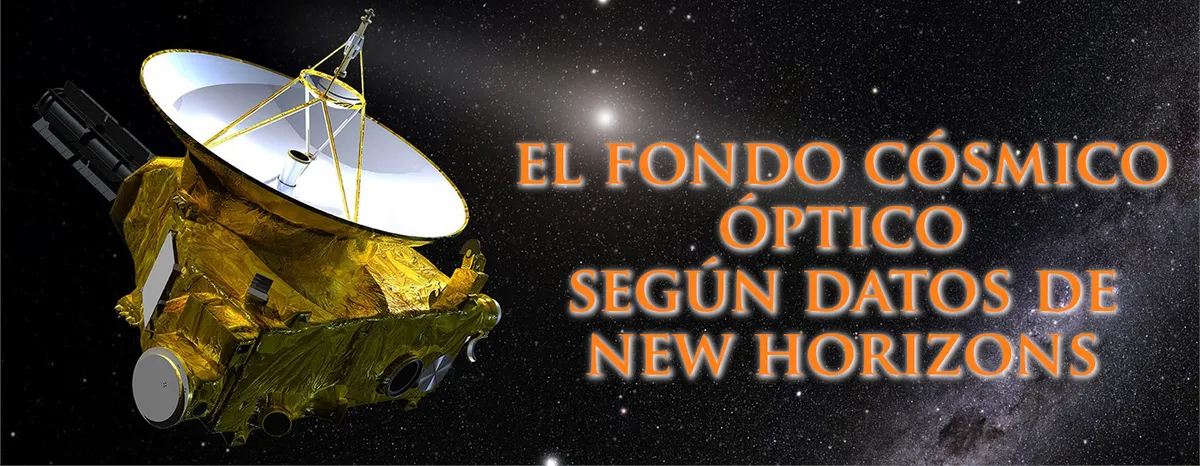
More than 18 years after launch and 9 since its historic exploration of Pluto, NASA's New Horizons spacecraft is over 7 billion kilometers from Earth. At that distance, little sunlight arrives, and with its instruments, astronomers are trying to answer the question: how dark is the universe?
Marc Postman and others have an answer: "We now have a good idea of how dark space really is. The results show that the vast majority of the visible light we receive from the universe was generated in galaxies. Furthermore, we found no evidence of significant levels of light produced by unknown sources," commented the astrophysicist. The result is not the first. A previous work, with the same instrument, had been done in 2021. For this new work, techniques not available before were used.
THE BACKGROUND LIGHT
In the 1960s, Penzias and Wilson discovered the cosmic microwave background radiation. Later, other cosmic background radiations in X-rays, gamma rays, and infrared were also detected, which also fill the sky.
To that, we must add the "ordinary" background, visible light, formally called the Cosmic Optical Background (COB).
The difficulty of the task lies in the fact that near Earth there is too much light from our Sun. Hence, the distant position of the spacecraft that NASA sent to Pluto in 2006 proves advantageous for this data collection.
New Horizons is already inside the Kuiper Belt, 57 times farther from the Sun than Earth. With its LORRI instrument—covered by the spacecraft—two dozen images were taken, which were added to others obtained by the European Space Agency's Planck mission in the far infrared and served to calibrate the optical background data due to the presence of dust.
The astronomers' conclusion is that the optical background (COB) is completely due to galaxies.

Here we see a graph (Fig. 9 in the paper) showing the amplitudes of the known components of the sky for 16 COB fields. The horizontal black lines show the measured values for each field, ordered by ascending level.
If the Universe had existed for infinite time, there would be infinite stars and galaxies and the night sky would be as bright as day. As is logical, infinity generates endless problems. The good thing is that the light count won't be that high, after all. Remember: if you want to travel to deep space, don't panic: bring a flare. And a towel...☉
Sources and related links
- New Synoptic Observations of the Cosmic Optical Background with New Horizons
Marc Postman et al 2024 ApJ 972 95
DOI 10.3847/1538-4357/ad5ffc
https://iopscience.iop.org/article/10.3847/1538-4357/ad5ffc - New Horizons Measurements Shed New Light on the Darkness of the Universe
https://hubblesite.org/contents/news-releases/2024/news-2024-029 - New Horizons Spacecraft Answers Question: How Dark Is Space?
https://hubblesite.org/contents/news-releases/2021/news-2021-001
About the images
NASA, Joseph Olmsted (STScI)
Marc Postman et al 2024