What does Google say?
In the latest issue of CAP Journal, Chris Impey (Steward Observatory, University of Arizona) tracks how pseudosciences are prevailing over sciences in beliefs and discourses. For this purpose, the researcher relies on surveys and searches on Google and in particular Google Books.
Below, as a summary, I show the five figures used in the article:
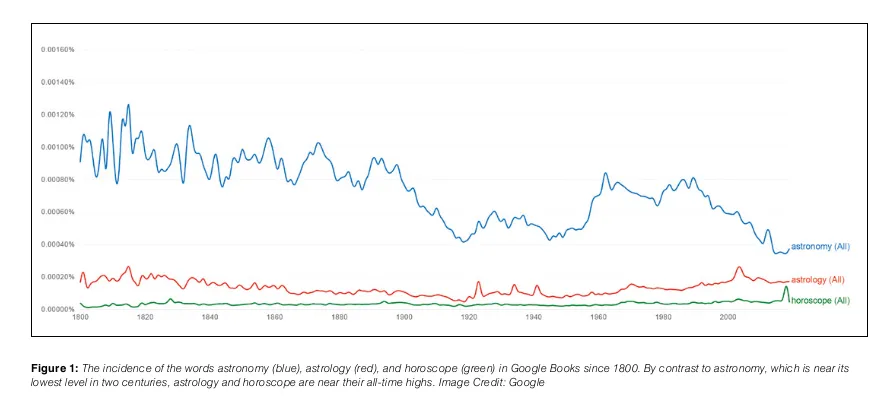
Fig. 1 shows the incidence of the words astronomy (blue), astrology (red) and horoscope (green) in Google Books since 1800. In contrast to astronomy, which is near its lowest level in two centuries, astrology and horoscope are at their highest.
In the next figure, it shows, at the top, the incidence of the acronym UFO (blue) and the word extraterrestrial (red) in Google Books since 1920. Both show a marked rise since 1947. Bottom: incidence of the phrases alien abduction (blue), crop circle (red) and ancient astronaut (green) in the same source since 1990.
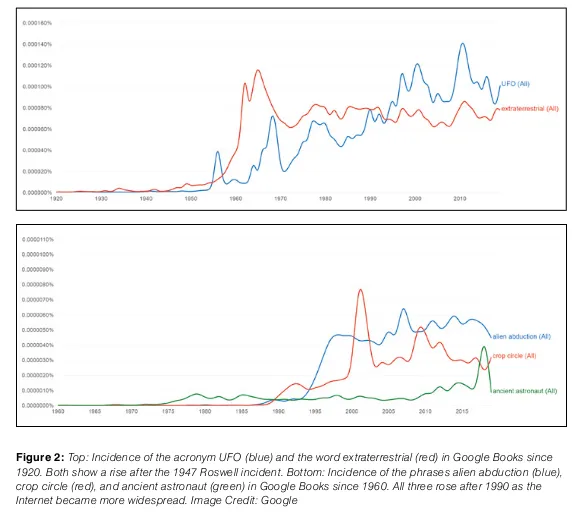
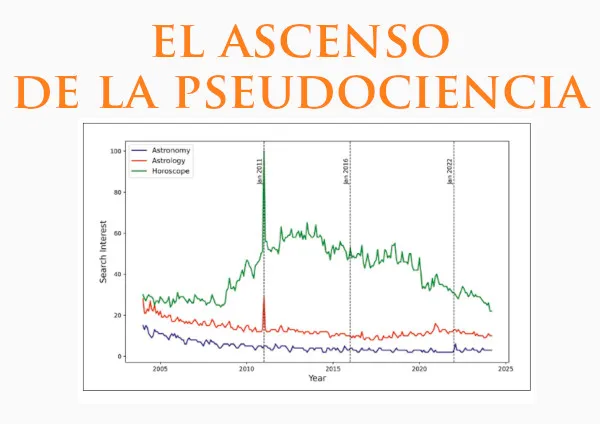
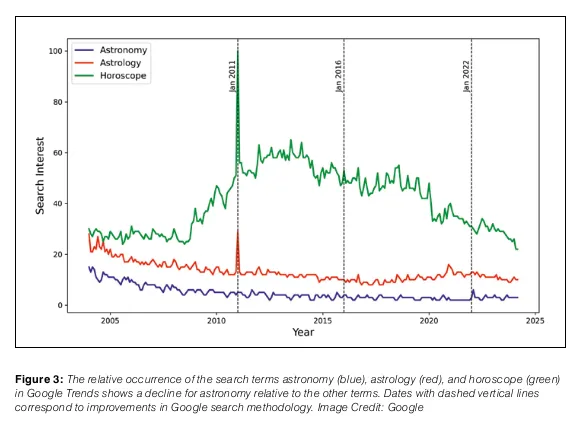
Fig. 3 shows the relevance of search terms: astronomy (blue), astrology (red) and horoscope (green) in Google Trends.
In Fig. 4 we see the occurrence of words like UFO (yellow) and astronomy (blue) in Google Trends. Bottom: alien abduction (purple), crop circles (green), ancient astronaut (red) in the same source.
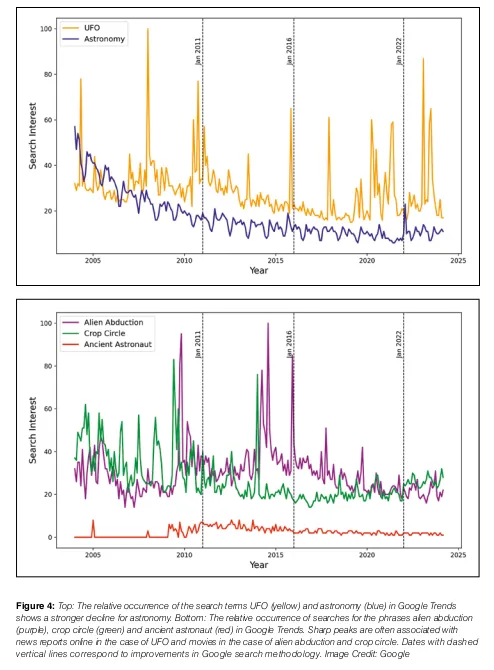
Fig. 5: Occurrence of the words science (blue), ghost (green) and angel (red) in Google Books. Bottom: the same for Google Trends.
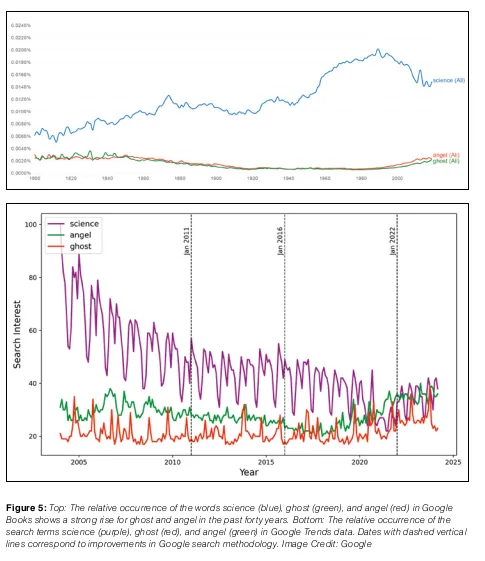
The author declares the limitations of these searches and comparisons. It is obvious that Google does not create content, but is used by the population to search for what interests them. And it is evident that, over time, pseudoscience concepts have not lost interest, but rather seem to have increased.
Social semiosis, the network of shared discourses, does not begin and end with Google or the internet. But it is evident that traditional TV, cinema, and paper books or newspapers have less weight in the circulation of discourses than digital media via the internet.
Some questions I always ask myself in the face of these studies are:
1- Is the public deceived by content creators or does the public believe in what it wants and makes it feel good?
2- Should journalism and communication offer what the public demands or the opposite?
3- Do people believe in "weird things" seriously or not so much?
I recently told here that on a TV program, on a news channel, an individual they call "professor" said that the moon has a dark side that sunlight does not reach because the moon does not rotate. The two journalists accompanying him said nothing. And the programs that make humor out of other TV programs' mistakes did not mention it. Probably, most of journalism thinks the same, despite the fact that the movements of the Moon and Earth are taught in high school.
What is not taught is what science consists of, how it is done, how many sciences there are, what differences they have, what the limitations of knowledge are, and to what extent one can know what objective reality is like. In some universities there is a course called Introduction to Scientific Knowledge, but the percentage of people who reach university is low.
If you allow me the irony, surely most educators and journalists are very credulous, probably because they were born with the Sun in Gemini...☉
COURSES AT THE PLANETARIUM
Planetario BA announces two free courses: Discover, Observe and Enjoy the Sky, by Diego Hernández, and General Astronomy Course, by Mariano Ribas.
More info on the Planetario Galileo Galilei website:
Discover, Observe and Enjoy the Sky https://planetario.buenosaires.gob.ar/descubrir-observar-y-disfrutar-el-cielo
General Astronomy Course https://planetario.buenosaires.gob.ar/curso-astronomia-general-0
Sources and related links
“The truth is out there”:
Tracking the rise of pseudoscience
Chris Impey
CAP Journal No.35 https://www.iau.org/news/announcements/detail/ann24021/
https://www.capjournal.org/
About the images
Credit: Impey-Google