The ratio between distance and period.
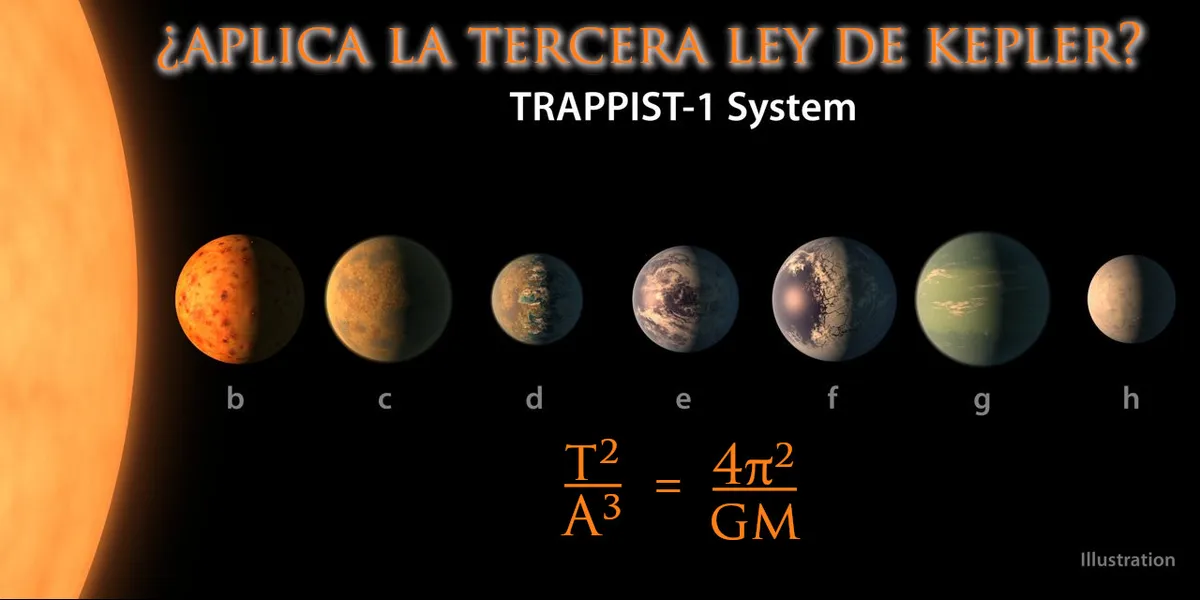
The star Trappist-1 is a red dwarf 40 light-years from Earth, in Aquarius, discovered in the year 2000. Its name comes from the TRAPPIST telescope (Transiting Planets and Planetesimals Small Telescope). Since 2016 exoplanets have been found and to date there are 7.
It is a very faint star, almost 9% of the mass of our Sun and 12% of its diameter.
Kepler's third law establishes a ratio between the distance of the planets from the star (the semi-major axis) and the period (the time it takes to orbit the star). The distance is often called "a" and the period "p" (sometimes "t", for time). Both measurements can be made in different units: astronomical unit or km for a; Earth days or years, for p. This ratio is: p^2/a^3. This quotient gives a value, a ratio, that is maintained in the system.
To be more precise, it is expressed as follows:
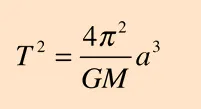
In the case of the solar system, it can be reduced to: p^2=a^3, if we use as units, AU and years, M=1 (and we convert the value of G to those units!).

But, is this valid beyond the Sun?
The Trappist-1 planetary system, having 7 planets, can be a good place to verify.
It is worth saying that the planets in this system are very close to each other, to the point that all 7 are at a smaller distance than Mercury from the Sun.
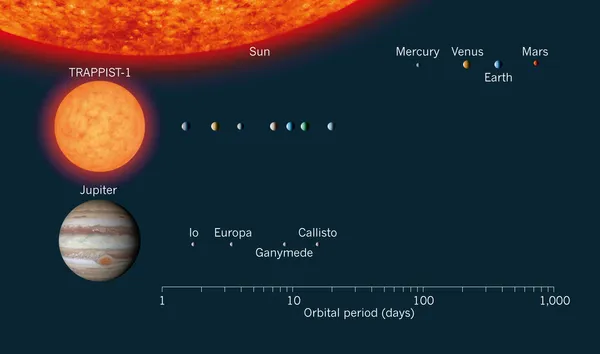
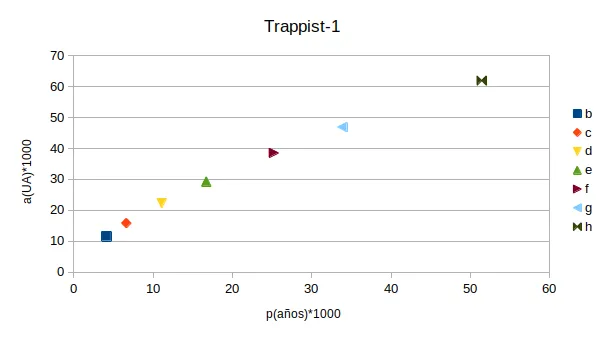
Taking available data from these exoplanets, using p in years, we see a ratio that is maintained in all seven cases:
Kepler wrote that he thought he was dreaming when he found this relationship. Later he wrote "Somnium" (The Dream or Astronomy of the Moon), considered one of the first science fiction novels. Then Newton would come to explain it. And later Einstein to do it better.
The German astronomer thought there was a "Harmony of the World" (Harmonices mundi), as if the planets were sounds on a cosmic staff.
Now we know that several things are not as Kepler thought, but at least in his three laws, we can say he hit the note.☉
Sources and related links
- Trappist-1
http://www.trappist.one/ - The Trappist-1 Solar System: Seven Earth-sized Planets Potentially Harboring Life
https://physicsfromplanetearth.wordpress.com/2017/03/19/the-trappist-1-solar-system-seven-earth-sized-planets-potentially-harboring-life/comment-page-1/
About the images
Credits: NASA/R. Hurt/T. Pyle
Nature