Arianespace launched 36 satellites for the Amazon Leo internet constellation onboard an Ariane 6 rocket on Tuesday, marking the tenth flight of the new European launcher. The LE-04 mission lifted off at 11:14 UTC from the Guiana Space Centre in French Guiana, one day later than initially planned due to a technical issue with the rocket's ground support systems. The mission lasted just over two hours and successfully deployed all satellites into a low Earth orbit at an altitude of approximately 460 kilometers. This was the fourth Ariane 6 launch for Amazon in 2026, bringing the total number of the company's satellites placed into orbit by Arianespace to 136.
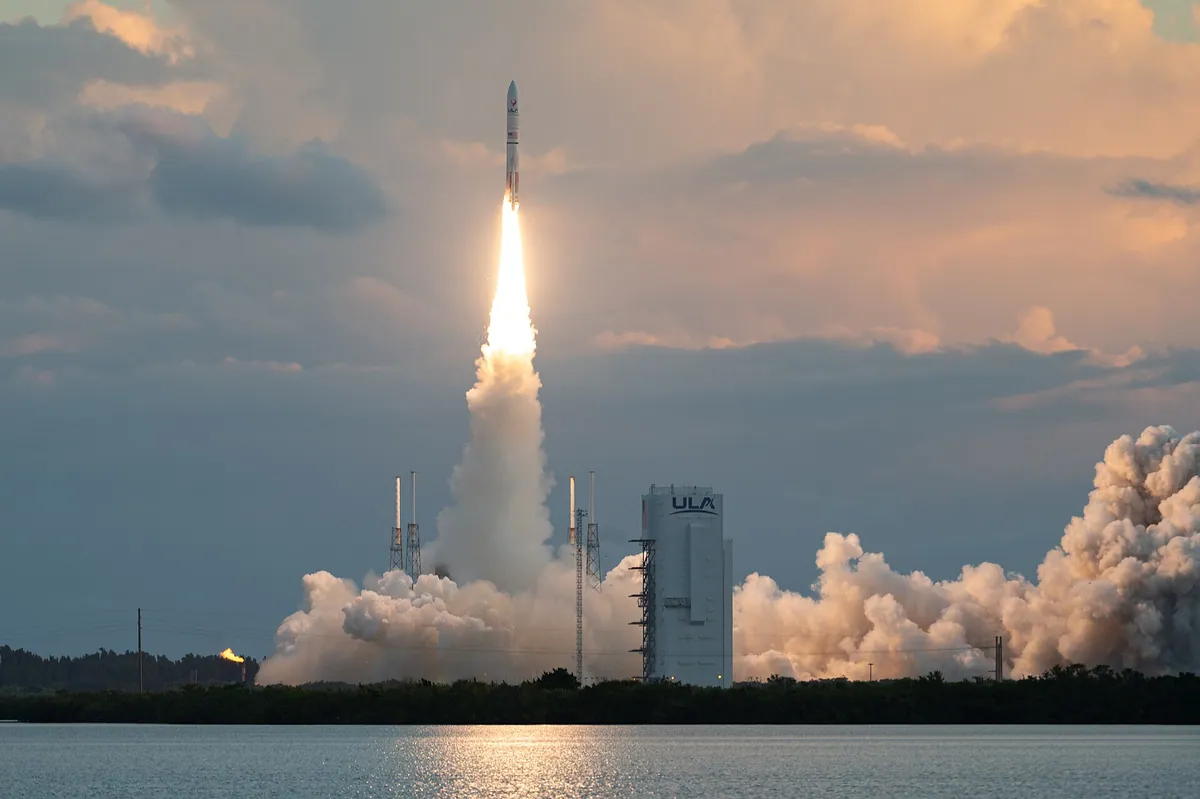
The flight occurred nine days after Amazon lost another 40 satellites in a failure of United Launch Alliance's Vulcan rocket. Amazon said in a statement following the anomaly that there is risk with any launch, and that is especially true for inaugural missions like LV-01. The company added that ULA has been a trusted partner and that it believes they will learn from this mission and deliver on their long term plans for Vulcan. The November 15 failure, caused by an issue with the rocket's main booster, was the first complete mission failure for ULA since its founding in 2006. The launcher used, designated VA271, was an Ariane 6 in its 64 configuration, equipped with four P160C solid rocket boosters. This was the first flight following the detection and correction of an issue with one of the turbopumps on the main Vulcain 2.1 engine, a problem discovered in August that had caused delays to the program.
According to a November 19 report by La Tribune, although the issue was resolved before today's flight, an additional engine test is planned for early December to fully validate the corrective measures. With this launch, the total number of Amazon Leo satellites in orbit rises to 432, including those launched by United Launch Alliance and SpaceX. The complete first generation constellation must consist of 3,232 spacecraft. Amazon announced in October that it had built its 1,000th satellite at its facilities in Kirkland, Washington. Originally, the US Federal Communications Commission required Amazon to deploy half of its constellation by July 30, 2026.
In January, the company requested a modification of that requirement, asking for a 24 month extension of the deadline. In a June order, Jay Schwarz, chief of the FCC's Space Bureau, wrote that at the time of the request, Amazon Leo reported it had launched 180 satellites and estimated it would deploy approximately 700 satellites by July 30, 2026. The order exempted Amazon from the 50 percent requirement, but the company must still deploy the complete first generation constellation by July 30, 2029. The order also referenced Amazon providing detailed schedules of future launches along with information on its financial and operational investments in the Gen1 constellation and its mitigation efforts to date.
The loss of launch capacity in 2026 is significant for Amazon. In addition to the Vulcan failure, Blue Origin's fourth New Glenn rocket, intended to launch 48 Amazon Leo satellites, was destroyed along with some launch infrastructure during a pad explosion during a static fire test of the BE 4 engines. The Amazon satellites were not onboard. Blue Origin, which had been working towards a return to flight by the end of the year, now expects its first flight in early 2027. In September, Amazon expanded its launch services agreement with Arianespace, ordering six additional Ariane 64 flights and bringing the total number of missions under contract to 24.
The next and likely final flight of the Ariane 6 in 2026 is scheduled for December 17. That mission, the rocket's eleventh, will carry the MetOp SG B1 weather satellite into orbit for European operator EUMETSAT. If it proceeds, Arianespace will have completed six Ariane 6 flights in 2026, a notable increase from the four flights in 2025, but at the lower end of the company's initial target of between six and eight launches. In April 2022, Amazon selected Arianespace to fly 18 missions for its constellation, in an announcement that also included 38 Vulcan launches and 12 on Blue Origin's New Glenn rockets.