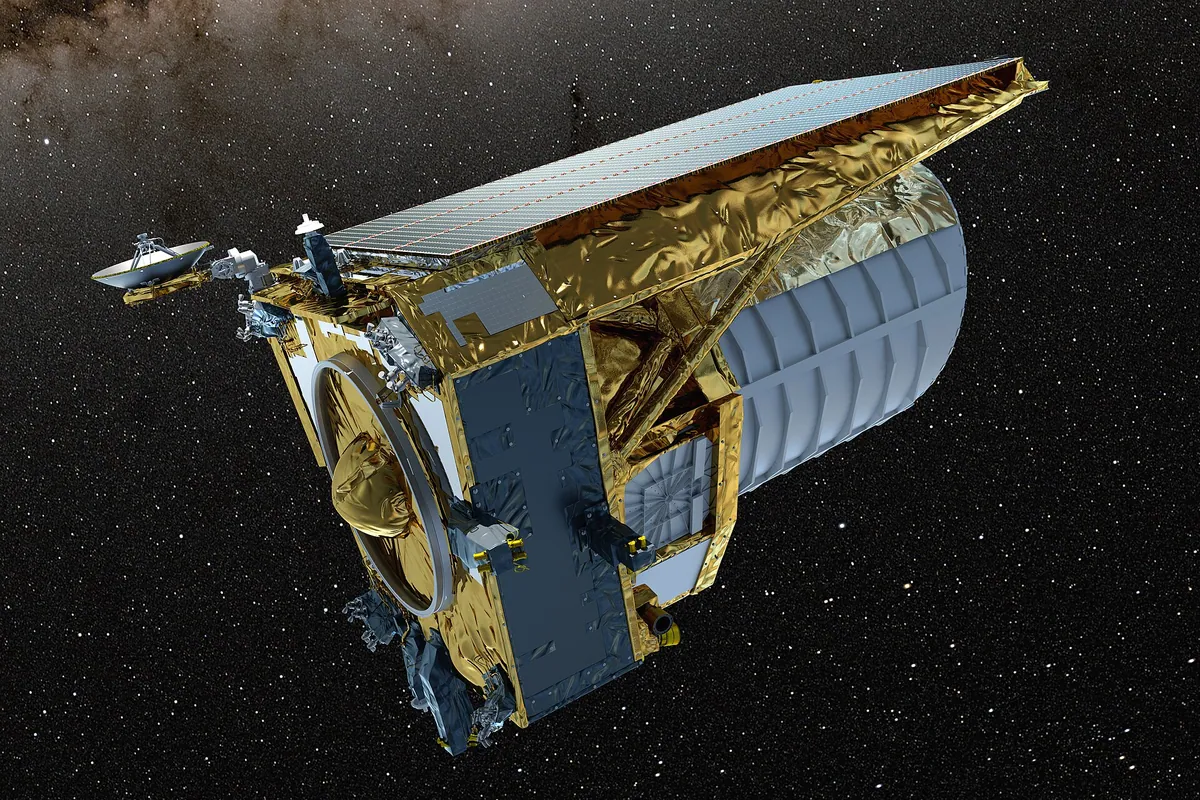
The European Space Agency's Euclid space telescope has discovered the most distant quasar observed to date. This galactic core, which hosts a supermassive black hole of about 360 million solar masses, is seen when the universe was only 630 million years old. The finding, published in Astronomy and Astrophysics, surpasses the previous record, which also belonged to Euclid, by 40 million years. This discovery raises a fundamental question about how such an enormous black hole could have formed and grown so rapidly after the Big Bang.
A quasar is the extremely bright core of a galaxy, where a supermassive black hole attracts gas and releases colossal amounts of energy. This phase, although brief, can make the nucleus outshine the rest of the galaxy. The team, led by Julien Wolf of the Max Planck Institute for Astronomy, identified Dún Aonghasa as a red dot among millions of objects in about 18 months of data from the Euclid Wide Survey mission. Follow-up observations with ground and space telescopes confirmed its nature and distance.
Daming Yang, an astronomer at Leiden University who participated in the study using the Hubble and Webb telescopes, explained that the discovery of a quasar beyond a redshift of 8 has been a long-awaited milestone for the scientific community. The redshift, a measure of how much the light has stretched due to the expansion of the universe, is 8.13 for this object, which means its light has traveled about 13.1 billion years to reach us. The James Webb Space Telescope (JWST) was key to determining the mass of the central black hole, which reaches approximately 360 million times the mass of the Sun. Julien Wolf noted that finding quasars at ever greater distances, at the edge of the observable universe, teaches something about how the black holes at their centers grew. According to Wolf, the closer to the Big Bang they are found, the faster their black holes must have grown or the more massive they must have been at birth, or both.
An Extremely Rapid Early Growth
What makes Dún Aonghasa special is that it consumes material at a relatively slow rate at the observed epoch. To reach its current mass of 360 million suns, its black hole must have had episodes of extremely rapid growth very early in the history of the universe. This puts pressure on models of primordial black hole formation and growth. Even growing at the theoretical Eddington limit, a black hole doubles its mass approximately every 30 million years. Starting from a seed of 100 solar masses, it would take about 700 million years to reach its current mass, but the available time is insufficient. Therefore, astrophysicists consider much heavier initial seeds or periods of growth that exceed the Eddington limit.
Euclid, launched in 2023 with the primary mission of studying dark matter and dark energy, has become a unique tool for hunting ancient quasars thanks to its combination of highly sensitive infrared imaging and exceptionally wide sky coverage. In just a year and a half of operations, it has announced the discovery of 31 ancient quasars. Of these, 12 are beyond a redshift of 7, more than double the number previously known at that distance, a threshold that took previous surveys 15 years to reach. Quasars as distant as Dún Aonghasa are extremely rare.
It is expected that, at most, a few dozen examples beyond a redshift of 8 will be found in Euclid's entire survey. Beyond their value for understanding black hole growth, these objects are unique cosmic beacons. Their light, traveling towards Earth, passes through the neutral hydrogen gas that filled the young universe before the epoch of reionization. Studying the traces of this gas in their spectra allows astronomers to investigate how the first stars and galaxies ionized their surroundings and transformed a dark universe into one transparent to light. According to Daming Yang, the quasar provides the first opportunity to study the gas between galaxies at a redshift greater than 8 along the path of its light.