Scientists have found evidence of four possible lava tunnels, or volcanic tubes, hidden beneath the surface of the Moon. Each could be more than a kilometer wide and buried under only about 100 meters of lunar rock. The detection was made by analyzing subtle variations in the Moon's gravitational field, measured by NASA's GRAIL mission. These underground structures represent a window into the Moon's geological history and, in the future, could serve as natural shelters for explorers, protecting them from intense radiation and extreme temperatures. However, the researchers warn that for now they are only candidates requiring confirmation by other techniques.
The finding is the work of geoscientists Juan Losarcos and Andrew Dombard of the University of Illinois Chicago. They used a high-resolution model of the lunar gravitational field published by NASA in May 2025. They carefully mapped small dips in gravity, after accounting for surface topography, and compared these signals with simulations of the gravitational effects that hollow tunnels of different dimensions would produce. Then, they cross-checked this data with geological observations of the lunar surface looking for features that would support the presence of an underground cavity.
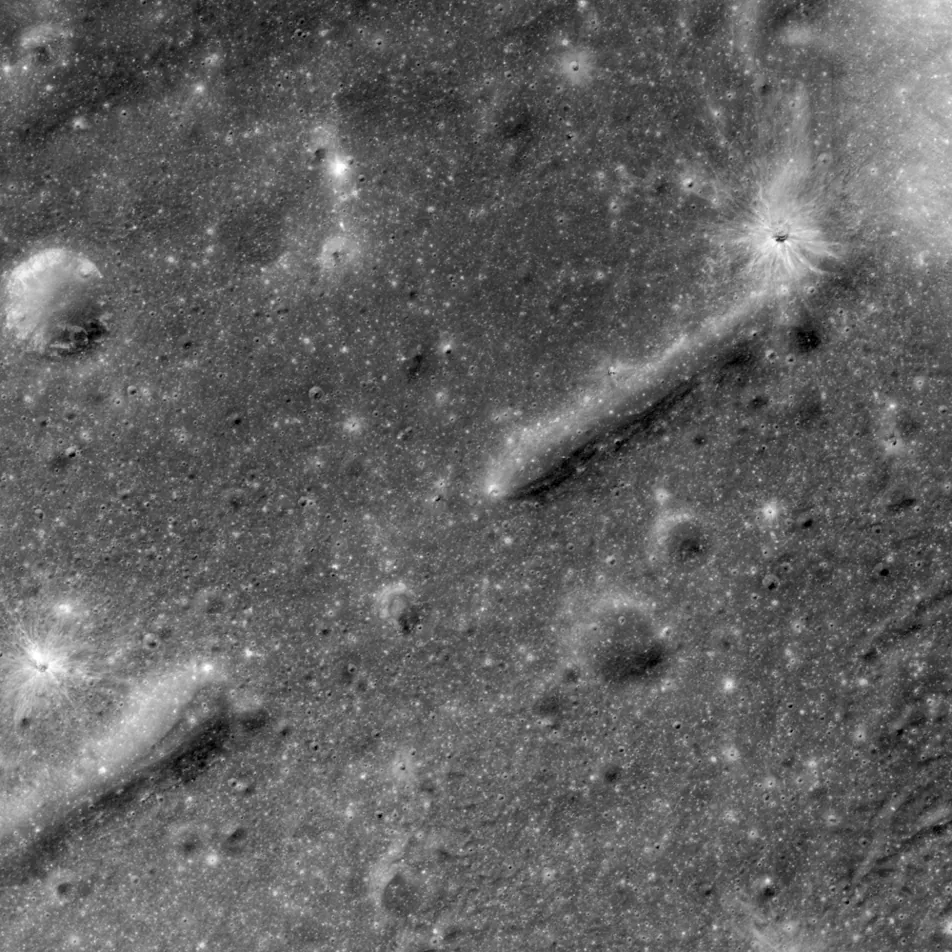
Four locations stood out as promising candidates. One is found near Vallis Schröteri, the largest sinuous rille on the Moon. Another is at Rima Mairan, and the remaining two are located near the Wollaston crater. In all cases, the gravitational signature is consistent with a tunnel less than two kilometers wide, buried under approximately 100 meters of rock. These dimensions are more in line with what is currently known about the structural limitations of lunar lava tubes, unlike previous estimates that suggested tunnels up to nine kilometers wide, likely too large for their roofs to hold.
The researchers propose that these possible tunnels could have formed in a slightly different way than the typical process. Instead of forming as a roof over a vast, open river of lava, they might have started as much smaller underground channels that gradually enlarged as the molten rock flowing through them melted and eroded the surrounding material. The surface geological features associated with the four candidates support this formation hypothesis. However, the scientists emphasize that, at this point, the four structures can only be classified as candidates, not as confirmed detections. Other variations in lunar rock density could produce similar gravitational signatures, and gravity data alone does not allow for direct measurement of cavity dimensions. According to the researchers, tubes that are completely intact could preserve key evidence about the Moon's volcanic and thermal evolution, even if accessing them is more difficult.
Definitive confirmation will require future observations with other technologies. Radar studies and more detailed geological mapping could help establish if the tunnels really exist. The researchers also note that their method, which relies on geological clues on the surface, could have difficulty detecting completely intact lava tubes whose roofs show no visible collapses or skylights. This suggests the Moon could be hiding more underground passageways than its surface lets on.
The search for lunar lava tubes has been a scientific goal for a long time. On Earth, these structures form when the surface of a lava flow cools and solidifies, creating an insulating roof beneath which molten rock continues to flow. When the eruption ends and the remaining lava drains away, a hollow tunnel is left. On the Moon, due to weaker gravity, higher eruption rates, and the ease with which lava flowed, these structures could reach dimensions that dwarf their terrestrial counterparts.
NASA's GRAIL mission, which operated between 2011 and 2012, was key to this advance. Its twin spacecraft mapped the Moon's gravitational field in unprecedented detail, measuring tiny changes in the distance between them as they flew over regions with different gravity. That data has allowed scientists to infer the subsurface structure. Meanwhile, missions like the Lunar Reconnaissance Orbiter (LRO) have identified from above numerous deep pits on the surface that could be entrances to these tunnels, such as the Mare Tranquillitatis pit crater, which is over 100 meters deep.