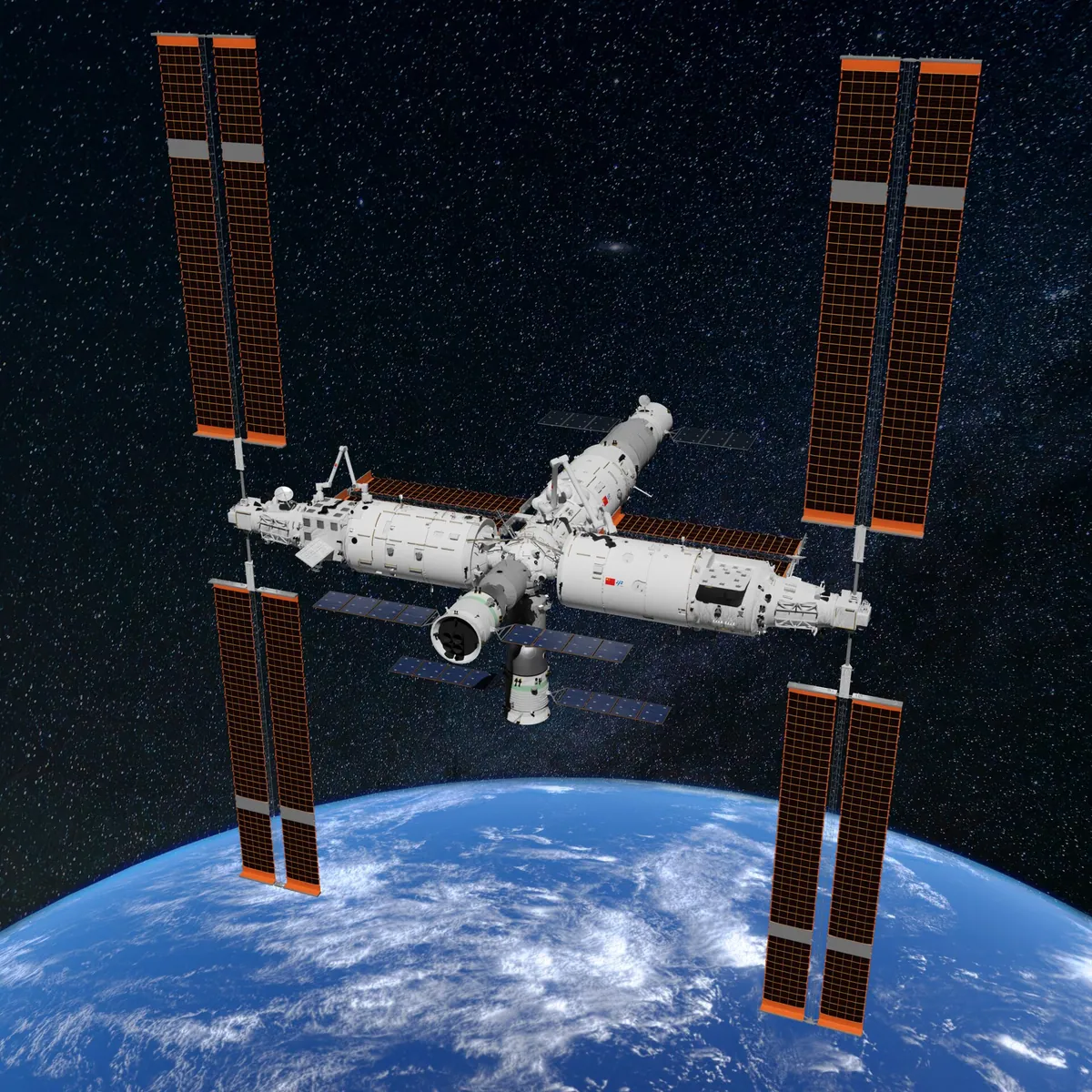
A Pakistani astronaut has become the first international visitor to China's Tiangong space station. Payload specialist Muhammad Zeeshan Ali arrived at the orbital complex aboard the Shenzhou-24 spacecraft, which launched on November 25 at 00:18 UTC from the Jiuquan Satellite Launch Center in northwest China. The mission marks a milestone in China's crewed space program, which until now had only transported its own citizens. Ali will remain on the station for approximately one week before returning to Earth, while his two Chinese crewmates will complete a six-month stay.
The Shenzhou-24 spacecraft docked with the Tianhe module of the Tiangong station at 03:56 UTC, about three and a half hours after launch. On board were Chinese commander Tang Hongbo, flight engineer Wu Yi, and Pakistani astronaut Muhammad Zeeshan Ali. Tang Hongbo thus becomes the first Chinese astronaut to visit the Tiangong station on three occasions, following his previous Shenzhou-12 and Shenzhou-17 missions, while Wu Yi is on his first spaceflight. Muhammad Zeeshan Ali, a 40-year-old former Pakistan Air Force pilot, was selected for this mission following a space cooperation agreement signed between China and Pakistan in February 2025. Along with another Pakistani pilot, Khurram Daud, who served as backup, Ali began his seven-month training at the China Astronaut Research and Training Center in Beijing in April, where he received technical training, learned Mandarin, and prepared in emergency procedures.
During his short stay in orbit, Ali will conduct a series of joint scientific experiments between China and Pakistan. According to the China Manned Space Agency (CMSA), he is scheduled to perform four collaborative projects in the fields of biotechnology and materials science. One experiment will study photosynthetic cyanobacteria in microgravity. Another will analyze how space radiation and microgravity affect the genetic and nutritional properties of quinoa seeds, a potential food for future long-duration missions.
Ali's return to Earth is scheduled for within a few days, when he will travel back aboard the Shenzhou-23 spacecraft along with two of the three crew members currently residing on Tiangong. The third member of Shenzhou-23, commander Zhu Yangzhu, will remain on the station to complete a record one-year stay, becoming the first Chinese astronaut to spend twelve consecutive months in space. This long-duration experiment seeks to better understand the effects of prolonged microgravity on the human body, key knowledge for future missions to the Moon and Mars. The Shenzhou-24 mission is the twelfth crewed mission to the Tiangong station and the eighth of its operational phase. The launch was performed with a Chang Zheng 2F/G rocket, the only Chinese vehicle currently certified for crewed flights. To ensure success despite the low November temperatures in the Gobi Desert, special measures were implemented on the launch platform, including climate control in the tower and thermal insulation for the rocket and spacecraft.
The arrival of the first foreign astronaut at Tiangong represents a significant step in China's space diplomacy. Excluded from participation in the International Space Station due to US restrictions, China has built its own orbital laboratory and now presents it as a platform for international cooperation. The CMSA noted in a statement that the Chinese space station is always something to look forward to and that it welcomes partners from all over the world. The mission coincides with the 75th anniversary of diplomatic relations between China and Pakistan, and the mission patch incorporates jasmine, the Pakistani national flower.
For Pakistan, Ali becomes the first citizen of the country to reach Earth orbit, though not the first Pakistani in space, a distinction held by tourist Namira Salim, who took a suborbital flight with Virgin Galactic in October 2023. China continues to develop its long-term space ambitions, with the stated goal of landing astronauts on the lunar surface before 2030. To this end, it is developing the new Chang Zheng 10 family of rockets and the next-generation Mengzhou crewed spacecraft. In parallel, it is working with Russia on a project to establish a lunar scientific base around 2035.