The doubts that arise in the public when one day one thing is said and then another were brought to the table by an important Argentine newspaper. Why does it happen?
The problem with the article is that it does not attempt to explain why there are contradictions in science. It does point out that there are economic interests that often influence, for example, pharmaceutical laboratories.
It alludes to the importance of critical judgment, but the cause is raised on the grounds of the supposed 'neutrality' of science. In short, the article suggests that scientists claim to be good, but they are not always. They have interests.
I understand that in the mass media these issues cannot be explored in depth. However, what is the message?
And it gives the feeling that the message a reader might interpret is that science is useless because it is contradictory and it is so because they 'want to sell us things'.
If we say nothing more, the reductionism we will have done will be remarkable. In particular because part of the problem lies with the media themselves, about which nothing is said.
As the problem indeed has many aspects, I would like to comment here only on some. I link, below, another post written today by a colleague that also deals with the topic.
The article in question is: Science contradicts science, a contribution to the general confusion.
The question of method: science in progress
Suppose you do not know why it rains. You investigate. You go outside every time it rains. You note some environmental variables: the birds, the trees, the clouds. If you go out many times you will have noticed a pattern: the clouds are always there (because you only go out when it rains).
If every time it rains there are clouds, it is likely that the clouds cause the rain.
The latter is a conclusion and you share it with your wife.
Then, you yourself or another person easily falsifies that conclusion. You go out when it is not raining and if you do so on many occasions you will notice that there are days when there are clouds, but it does not rain.
Your previous conclusion is false. Completely? Perhaps rain is a determining factor, but not the only one.
You tell this to your wife, who looks at you and says, 'Your conclusions are worthless, they are contradictory. Either it rains because there are clouds or it doesn't.'
But you now, after a process somewhat similar to that, and after many other steps that allow understanding the water cycle, you already know that they are not contradictory: when there are clouds it may rain or not, but every time it rains there are clouds. And you can understand the conclusions in a context.
Now that you know this, when you read a science article in the newspaper you wonder: will this conclusion be like the ones I was drawing provisionally in the previous case?
Human beings notice causal relationships in Nature. But those relationships can be one-to-one, many-to-one, etc.
Several different causes can generate the same effect (like fire is produced by lighters, friction stones, etc.) or various factors can combine to produce an effect, as in the previous case where clouds are not sufficient, but are necessary, to generate rain.
The same happens with health. If many people who say they drink milk with iron later get sick, we investigate. But to reach a good conclusion we will go through several 'weak conclusions,' while trying to isolate variables.
If you had a computer virus on your PC and you know that you recently installed two programs and want to know the cause of the virus (not just fix the problem), the logical thing is to uninstall ONE program, see what happens, and if nothing happened, do the same with the other. You are 'isolating' variables that potentially are the cause.
But it also happens that perhaps you downloaded another software without realizing it, when entering a web page, for example, and that variable you are not going to consider 'a priori'. Only after much investigation is it possible that you find it.
The path of science is a journey by which we try, laboriously, to separate variables so as not to be deceived by the apparent. That path involves several steps and counter-steps, it is not just a statistical study and that's it. On that path, researchers can continue 'being deceived by the apparent,' but less and less.
In the previous example, every time you told your supposed wife your conclusions is similar to the publication of a scientific work or paper.
When you tell your wife there is no journalist running to publish that in a newspaper, but nowadays, yes they are every time a paper is published. And it has space in the mass media because supposedly they have an impact on our quality of life.
That is why there are many more science/health news than astronomy news in the mass media, although there are also 'contradictions' in the search for dark matter (Is it a problem with gravity theories, is it ordinary matter that does not shine, or is it extraordinary matter?).
I say this because contradictions are commonly understood as something negative. I show these simple examples to realize that they are not always so. Thanks to contradictions, science advances because we realize that previous knowledge is insufficient and that drives us to try to complete it.
Only after much walking can we reach 'firm' conclusions. They do not imply their absolute certainty or validity, but they allow us to be more confident. In some cases very confident, within a certain context.
Some of the scientific 'contradictions' related to health can then be understood in this sense. But if we do so, their impact will be less, to such an extent that it would not have deserved space in the press.
The journalist's problem
This does not mean that those investigations should not be disseminated, but it does imply taking into account what was said before and reporting it explicitly: they are usually 'science in progress,' conclusions useful for continuing research, provisional in that sense. It does not mean we should change our habits because of them.
On the other hand, if we are going to talk about smoking, whose effects are more than proven, we can indeed emphasize the need to change habits since it is clear that it is harmful.
But for this, one must have not only awareness of the context, but also know how to interpret the studies, which are mostly statistical.
How many cases, what variables, under what circumstances, what results?
Recently I commented here on a study about supposed "precognition". For that, I dissected the study a bit. First to understand it myself, and then to be able to share a series of data about how it was conducted. At the end, I gave a personal opinion, which the reader may or may not share, but will at least have information and explanation.
It is vital that this is reported and sought by the reader. If we are going to discard those studies because they do not seem "reliable" to us (few cases, for example, insignificant results, etc.), let's still keep the above in mind. It's not that it's useless; it is useful in the context of research, even if it is not yet ready to impact our daily lives.
The problem of the media and the reader
Other problems arise in scientific communication. Partly due to the media. Just yesterday I was discussing with a blogger friend who told me that in the media one ends up being "a victim of the target." That is, a mass media outlet addresses a specific audience, with certain knowledge and interests. The editor will not deviate from that framework, which limits them.
It's true that this also implies maximizing resources, to try to convey the most relevant information (the famous Ws in English), but in some cases vital information for full understanding is lost. Unless we give more space and make longer, somewhat more complicated explanations.
Daniel Collico Savio, a physicist from UBA, said regarding the book "El café de los científicos":
[...] Science communication is the product of two magnitudes in frank opposition: the rigor of the concept and the clarity to present it. A good balance of both is not always achieved, the communicator does not always come out successful[...]
The problem of the reader
But readers, at the same time, want neither equations nor long speeches. That's why in media like this blog we can afford to write without predetermined lengths, without a defined target.
This means that the media are not the way they are on a whim, but because readers, apparently, seek that. Concise, fast, useful, impactful, novel information. In ten lines. Or less.
And more
The influence of laboratories in generating press releases, the "Publish or perish" (which leads researchers to publish papers to give quantitative support to their work, to be valued in the scientific community), deeper epistemological problems (measurements, subjective viewpoint, etc.) are many other factors that can generate "contradictions" in science.
I don't want to reduce the problems to just the reader, the media, and the scientific method. But I do think that what has been said here can help us get an idea of what the supposed science/health "news" might (or might not) mean.
As readers we must be more demanding of the media and of ourselves. Reading these news items with a critical stance implies trying to know if it is a research in progress, an observation validated many times and under what circumstances.
In any case, if a news item touches us closely because we have a specific health problem or it happens to someone close, we should NOT be guided by what a newspaper says. It is a professional who should decide, after evaluating the specific patient, what the diagnosis and treatment are.
Let's not use the dissemination of research in progress to justify drinking wine, coffee, or whatever.
On the other hand, when we read that coffee is good and then that coffee is bad, we can understand: "they don't know, they are researching" or we can say "science is useless." Let's use critical thinking. Let's keep in mind that there are vested interests, that reductionism is done due to space constraints in the media, ignorance, or for didactic purposes. But let's also consider the context of the research and its value. No one is born knowing. Knowledge is not a magical act, from a single observation, from a miraculous appearance.
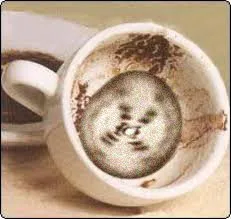
Otherwise, we will be reading the coffee grounds of science.
Sources and related links
- Ciencia, neutralidad y contradicciones, by Ángel "Java" López.
About the images
- The first image is modified from the original in the post Oro parece.
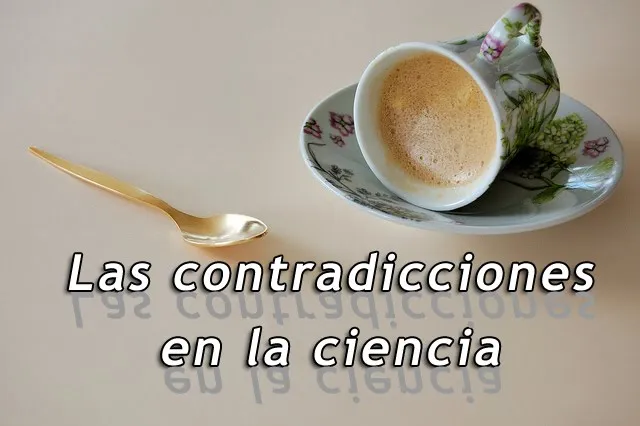
- The original image in the coffee grounds combination is from "La dama ausente: Rosalind Franklin y la doble hélice", by Manuel Vicente.
http://www.madrimasd.org/blogs/microbiologia/2008/08/10/98464