On potential dangers of asteroid collisions that swarm the web.
The Moon is full of craters, which is "impactful" when observed with a telescope or binoculars. Earth also has its scars, but with the passage of time, vegetation growth, rains, and human settlements, many craters are not recognized as such.
Although such impacts from the past give us the impression of being in permanent danger, one must think in the appropriate time scale, which is astronomical.
On the other hand, the danger is not necessarily out there. Consider that in the northwestern United States is the Yellowstone caldera. Geologists indicate that the last super-eruption was 640 thousand years ago, but there have been others more recent. The surface of the caldera is almost 4000 square kilometers. And it is very difficult to predict an eruption with much advance notice.
These days news circulated about two asteroids with potential danger because they would "graze" Earth: 2000 QW7 and FT3 2007, with their closest approach predicted for September 14 and October 3, respectively. Rivers of electronic texts have also been written about 99942 Apophis.
How to know if these, or any other case, are a danger?
The scientific scales
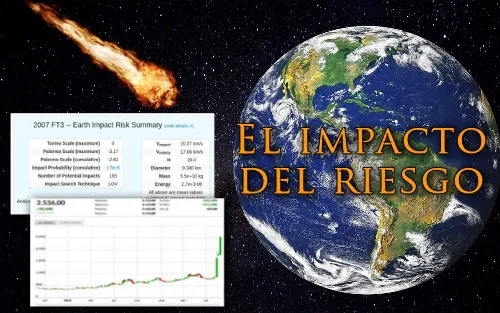
Similar to earthquakes, there are scales for measuring asteroid risk. The Torino Scale (created in 1999 by the IAU) assigns an integer from 0 to 10 to each object for which sufficient data is available, ranging from lesser to greater danger. The website that can be consulted about this scale includes a search engine. There, 2007 FT3 appears with a risk of 0. It must be kept in mind that a value of zero on this scale does not imply that the object will pass far away, but that it could be very small and disintegrate in the atmosphere. This is important to consider, since "collision" would imply that the object is large enough to reach the surface.
These scale values change over time, as more data is obtained on the objects.
In some media outlet (El Día de Gualeguaychú) an image of the simulation of the object's orbit was shown. But, curiously, although the article says the approach will be on October 3, the image indicates April 6.
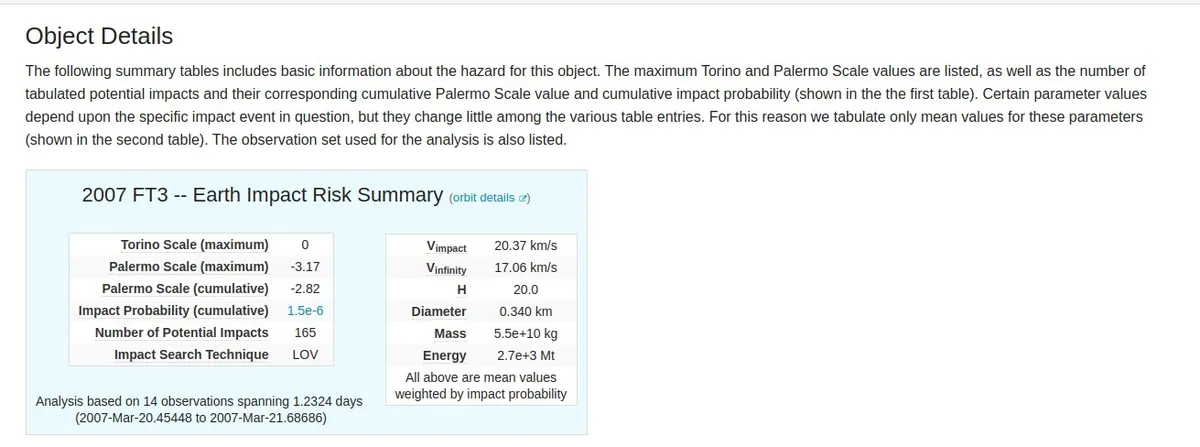
The Palermo Scale is used by specialists, it is a logarithmic scale and is used to choose which objects should have priority of study among those with zero risk on the Torino Scale.
PS = log10 R.
The Palermo Scale measures the risk R in base 10.
R is calculated as:
R = PI / (fB × DT)
where PI is the probability of impact and DT is the time until the potential event, in years. The variable fB (0.03 × E-4/5) is the annual probability of an impact with an amount of energy (E, in megatons) at least as large as that of the event in question.
On the NASA NEOs Center page we can access a table with close approach objects. There, the approximate calculated distance appears in two variants: lunar distance and astronomical units. The first unit is the number of times the object will pass in relation to the Earth-Moon distance (which is approximately 384 thousand kilometers). For the case of 467317 (2000 QW7) the minimum distance is 13.87 lunar distances, that is, it would pass at a distance that is 14 times the Earth-Moon distance.

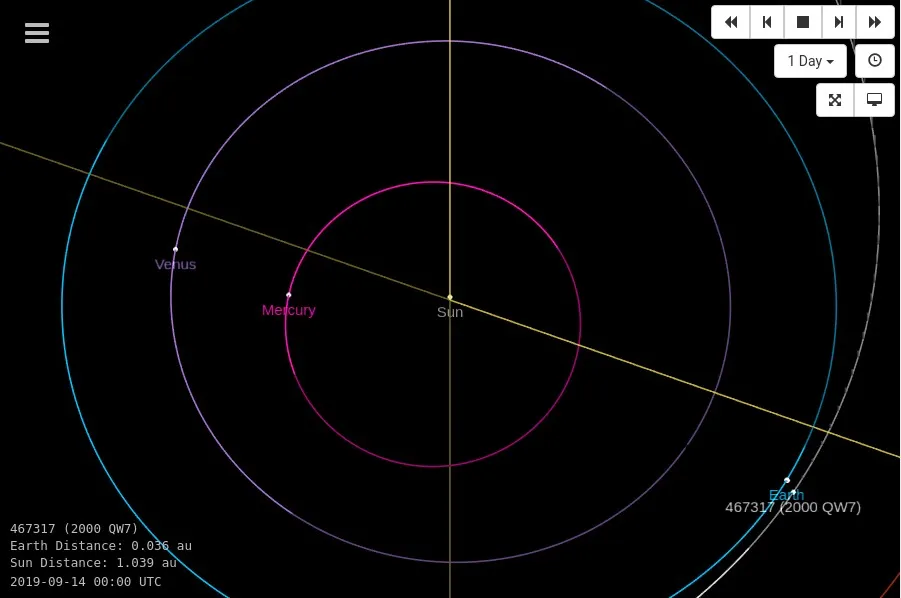
Another possibility for a web search on potentially hazardous objects is "NASA's Near Earth Asteroids and Comets Sentry Table" whose link I indicate at the end.
CONCLUSION
In many cases, alerts of potential asteroid impacts are fake news to sell clicks on the web. They seek to generate "impact" on the population under the assumption of a risk. I recommend looking for scientific information on the NASA websites indicated in the post.
We live in danger every day. But the risk of impact from these objects is zero. The country risk is much greater.
Sources and related links
- Torino Impact Hazard Scale
https://cneos.jpl.nasa.gov/sentry/torino_scale.html - Palermo Technical Impact Hazard Scale
https://cneos.jpl.nasa.gov/sentry/palermo_scale.html - JPL Small-Body Database Browser 467317 (2000 QW7)
https://ssd.jpl.nasa.gov/sbdb.cgi?sstr=467317 - NASA's Near Earth Asteroids and Comets Sentry Table
http://robertinventor.online/booklets/sentry_table_simplified.htm - El Día: La NASA explained the truth about the asteroid that will pass near Earth on October 3
https://www.eldiaonline.com/la-nasa-explico-la-verdad-el-asteroide-que-pasara-cerca-la-tierra-el-3-octubre-n1003186 - How to tell if an asteroid is going to kill you
https://cosmosmagazine.com/space/how-to-tell-if-an-asteroid-if-going-to-kill-you
Quantifying the risk posed by potential Earth impacts
Steven R. Chesley (JPL), Paul W. Chodas (JPL), Andrea Milani (Univ. Pisa), Giovanni B. Valsecchi (IASF-CNR) and Donald K. Yeomans (JPL)
Icarus 159, 423-432 (2002)
About the images
Pixabay https://pixabay.com/photos/asteroid-comet-meteorite-3628185/
NASA graphics https://cneos.jpl.nasa.gov/
https://ssd.jpl.nasa.gov/
Urgente24 graphic
El Riesgo País surpassed 2,500 bp and Fitch placed Argentina in "restricted default"