The JUNO detector began collecting data. Over the next 10 years it will track the elusive particles about which there is much to learn.
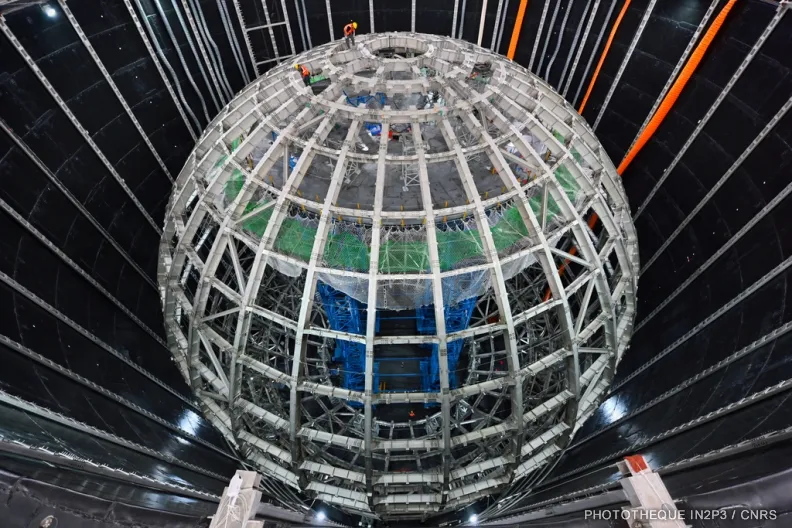
The device's name comes from Jiangmen Underground Neutrino Observatory. Located 700 meters underground between two large nuclear plants that provide an abundant flow of neutrinos, it consists of a spherical structure 35.4 meters in diameter filled with 20,000 tons of liquid. 43,212 photomultipliers are placed in the sphere to monitor any flash produced by the rare interaction of neutrinos with the liquid. The spherical tank is submerged in ultra-pure water.
One of the researchers' goals is to learn more about the phenomenon of neutrino oscillation: there are three types of neutrinos that can transform from one type to another, that is, oscillate.
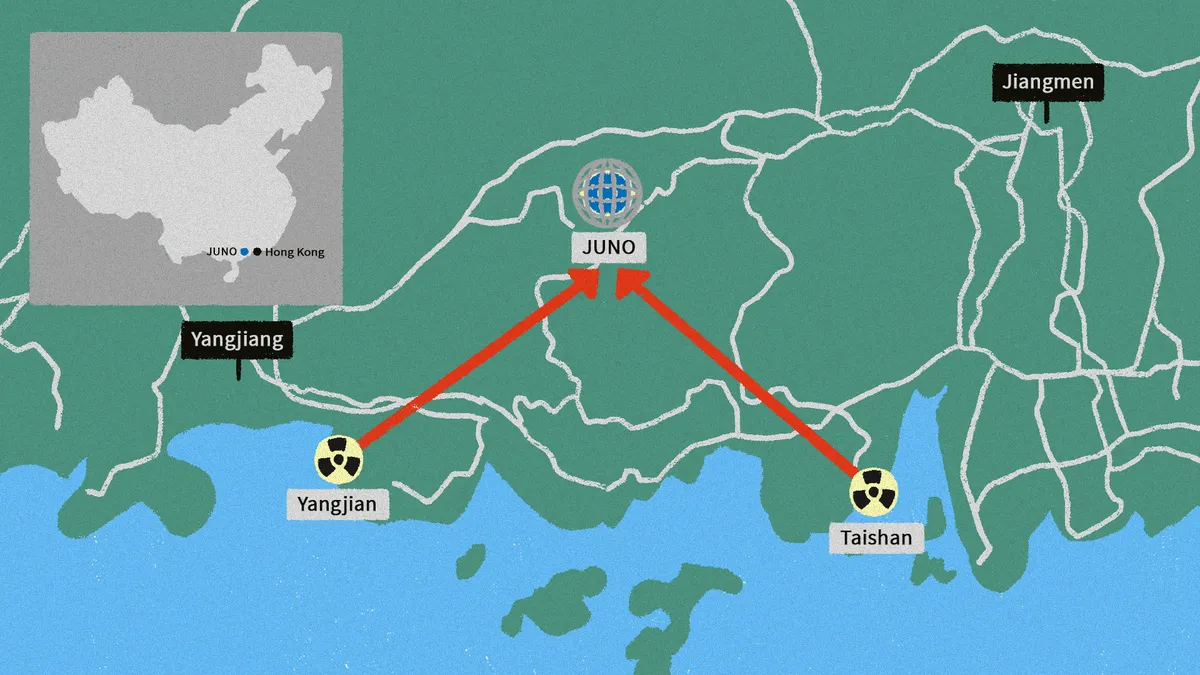
The initiative is the product of an international collaboration of 74 institutions from Asia, Europe and the Americas. It is led by the Chinese Academy of Sciences and France participates through the CNRS.
JUNO joins other neutrino observatories. We talked here about the detection of neutrinos as an early warning of supernovae and about the nascent neutrino astronomy.
Although the observatory's name may not have been intended, astrophysicists in the Río de la Plata will be able to say they are going to "junar" neutrinos. ☉
Sources and related links
- JUNO : a giant to listen to the discrete waltz of neutrinos
https://www.in2p3.cnrs.fr/en/cnrsinfo/juno-giant-listen-discrete-waltz-neutrinos - Timelapse of the construction of the JUNO neutrino detector
https://www.youtube.com/watch?v=yDIsoEUiXzc&ab_channel=CNRS-Endirectdeslabos - Lunfardo Junar
https://www.todotango.com/comunidad/lunfardo/termino.aspx?p=junar
About the images
Crédit : Clara Hinoveanu pour l'IN2P3/JUNO