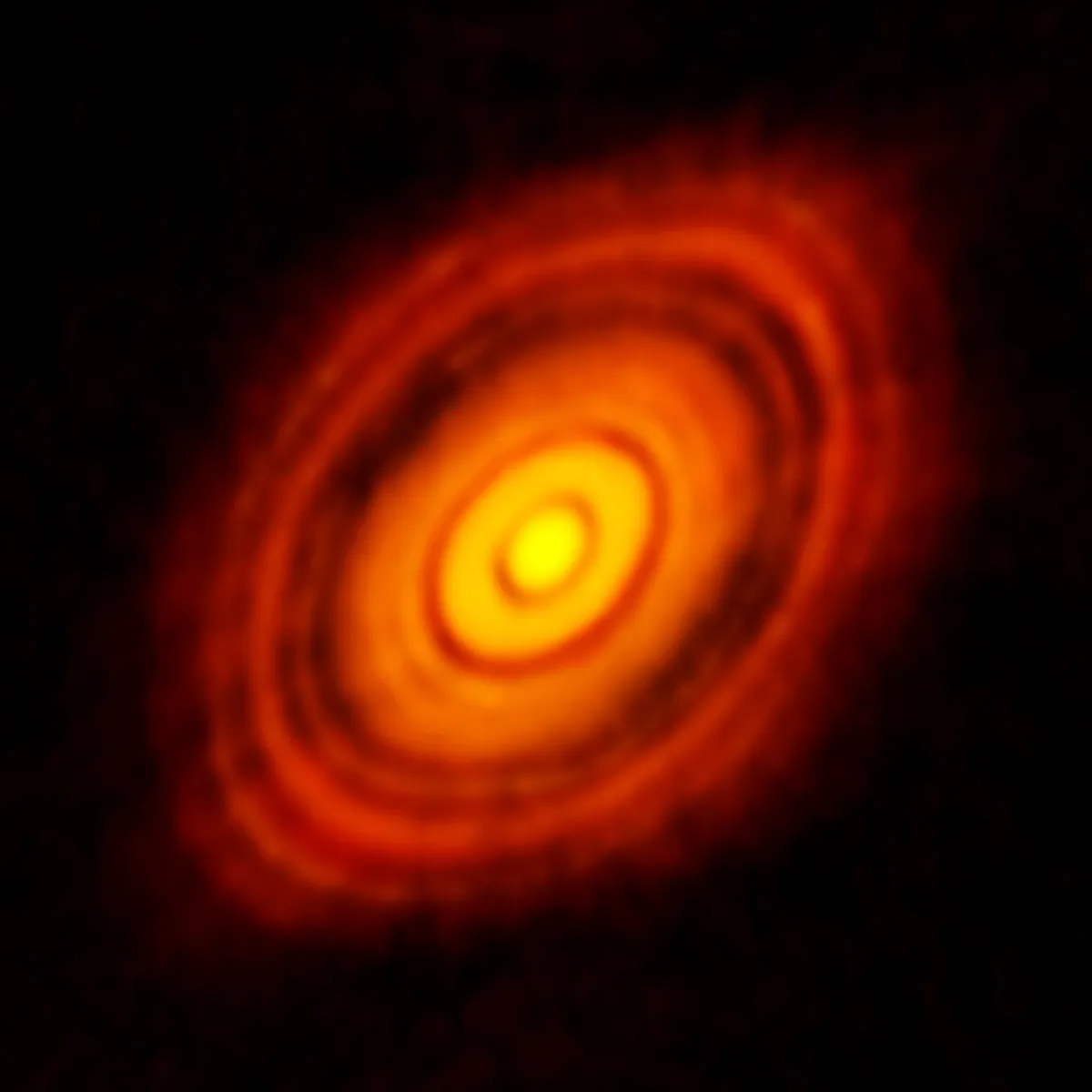
The rings and gaps in the dust disk surrounding the young star V1094 Scorpii are not solely due to planet formation, according to a new analysis of data from the ALMA observatory in Chile. A team of Japanese astronomers determined that only the innermost gap in the disk can be explained by the presence of a forming planet, while the outer rings are the product of a gravitational instability phenomenon. The results, published in The Astrophysical Journal, nuance the popular interpretation that every dark ring in a protoplanetary disk marks the orbit of a newborn planet. Masayuki Yamaguchi, a postdoctoral researcher at Kyushu University and lead author of the study, compared the pattern of concentric rings in these young disks to the grooves of a vinyl record. The researcher noted that the most popular explanation is that young planets create these gaps as they orbit, but that this becomes difficult to accept when a disk has many rings, since it is complicated to imagine that several planets have already formed.
V1094 Scorpii is a young star located about 500 light years away, with a giant protoplanetary disk extending to about 380 astronomical units (AU), approximately 13 times the distance between the Sun and Neptune. Within that radius, the researchers identified four narrow pairs of rings and gaps between 100 and 230 AU from the star's center. The team also traced an extended gas disk reaching about 760 AU that rotates in a Keplerian manner, meaning the material farther out orbits slower than that closer in. The star was first identified as a giant disk with multiple rings in a 2018 paper that used data from the Lupus survey, an ALMA campaign on disks in the Lupus star-forming complex.
The study did not request new observing time from the ALMA telescope, but instead applied an open-source super-resolution technique called PRIISM to existing data. This method is designed to produce sharper images from ALMA's interferometry data, replacing an earlier technique known as CLEAN. PRIISM was also used in a 2025 study that analyzed 78 disks in the Ophiuchus star-forming region. The researchers complemented their analysis with observations from the SPHERE instrument on the Very Large Telescope, which captures near-infrared light scattered by dust. By comparing the dimensions of the gaps with a model that assumes one planet in each, the team discovered this model could not explain the full observed pattern. Yamaguchi explained that the origin of the structures appears to differ from one place to another in the disk.
The results indicate the innermost gap, located at about 100 AU, is consistent with the excitation of multiple gaps by a single low-mass companion of 55 Earth masses, plus or minus 35. However, the outer rings, between 170 and 230 AU, show regular spacing and do not have a clear counterpart in the scattered light. The authors note that these outer rings are quantitatively compatible with secular gravitational instability. This phenomenon involves dust clumping under its own gravity, forming uniformly spaced rings, a process that requires a low-turbulence environment. Secular gravitational instability intrinsically produces uniformly spaced rings, while exoplanets do not.
In their conclusion, the authors write that V1094 Sco supports a hybrid pathway in which weak turbulence in an extended disk allows secular gravitational instability to assemble long-lived dust concentrations that can cradle planet formation beyond about 100 AU, alongside planet-driven substructures at intermediate radii. The findings do not mean planets never form in those outer regions, but rather that there are currently no planets forming there. The authors add that in this framework, secular gravitational instability does not compete with planet formation. Rather, it concentrates solids and establishes conditions across the disk favorable for subsequent planetary growth. The research shows the complexity of protoplanetary disks and how improved analytical tools, like PRIISM, can extract new insights from archival data.